Blurring the Lines

Content Warning: Politics

I have, so far, tried to keep my personal politics out of this blog but, today, I’m going to be discussing in more detail the panel I sat upon at Dublin Worldcon 2019. The theme was ‘How Creators and Fans Respond to Political Unrest’ and I cannot discuss that subject without sharing my own views. It is also an important question for all of us who create to consider. Do we attempt to keep our content free of politics? Or do we embrace and announce our personal opinions or explore the opinions of those we disagree with?

So, upon the bright and sunny morning of the Thursday of Worldcon, I trotted down toward the Point Square Odeon to sit on a panel that had been the source of some anxiety for me. A week or so before it was to be my first panel ever and the weight of the subject was quite daunting given the Global Political Climate. What were my intentions? Was I out to cause some uproar, did I want to avoid offending anyone, what was I going into this room to do? As I met and greeted the moderator, John R. Douglas (a Canadian National living in America) and the other panelists, Teresa Nielsen Hayden of Tor Books (a U.S. National), Michi Trota of Uncanny Magazine (a U.S. born Filipino) and Julia Rios (a U.S. born Latinx) I started to get an idea of  what I (a white, cis, U.K. National) had to offer.

We all introduced ourselves to the audience (a smaller gathering than I had expected but fiction is about escaping reality so it makes sense) and spoke a little about ourselves. Michi is a San Francisco resident and, although it is a ‘Sanctuary City’ and she is an U.S. resident, she still has concerns about I.C.E. (Immigration and Customs Enforcement) or the police and carries all her ID with her at all times. She even exchanges texts with her partner to reassure them that she’s gotten to work safely and let them know when to expect her home. Julia passes for white, and has done since their family essentially erased all Latino cultural elements from their upbringing so that they would pass, and even then they carry all their documents around in case of I.C.E. even John voiced concerns. Although he is a white male and therefore less likely to draw the casual attention of those organisation because he is an ‘alien’ living and working within the borders of an America that is rapidly growing more hostile to from outside it’s borders. I feel for Teresa, it’s quite heart-rending to hear someone apologising for the policies of their Government but it was not long after that I had to do the same.

The U.K.’s recent human rights record (and it’s not so recent record) is a disgrace. The stereotypical English persona (as I thought it a cross between Terry Thomas and Hugh Grant) has been almost completely replaced by the image of Football Hooligans, Racists and Neo-Fascists. ‘The Donald’ (a phrase I would say came about after a tan-Trump over not being able to copyright the name) has bombastically presented his intentions to stop Southern and Middle Americans, refugee’s from poverty, corrupt Governments and drug Cartels (but not, importantly, active war zones) entering the U.S. but, the U.K.’s Conservative Government have (with the assistance of their partner, media mogul Rupert Murdoch) have been demonising immigrants and refugee’s and actively blurring the line between the two, for over a decade now. The Syrian Refugee camps are still in Calais and, between restricting the number of refugee’s allowed into the U.K. and generating the so-called ‘Hostile Atmosphere’ toward immigrants, Conservative PM’s like Cameron, May and Johnson have personally contributed to a humanitarian crisis of biblical proportions. If you then factor in austerity and the ongoing erosion of our Social Care system and support for the Aged, the Disabled and anyone beneath a certain income bracket and you see the class divide isn’t going away and the subtle, sinister attacks by certain elements of the social elite are progressing with thoughtless cruelty against the most vulnerable people in society.

So where does that leave us creatives? With comedy satires like ‘Yes Minister?’ and ‘The New Statesman‘ actually becoming more accurate representations of the goings-on of Government has Satire lost it’s teeth? With Dystopian fictions like Orwell’s ‘1984‘ and Alan Moore’s ‘V for Vendetta‘ more representative of our media and social culture what do we do? The world is a far more cynical place than it has ever been and we haven’t really touched on Corporate Culture of Religion yet (although, if your deity or scripture compels you to enact violence against other over a difference of belief you might as well raise an altar to Ash Ketchum in my opinion), so what is our message? Times have changed since Aesop’s fables and the stories we consume are more complex. Moral ambiguity as found in ‘Hannibal‘, ‘Dexter‘ and ‘The Punisher‘ is far more commonplace. We live in a time where the heroes don’t always win and the villains don’t always come to justice, times when the ‘good guys’ are found to have their own dark secrets and the ‘bad guys’ are shown to be not monsters but simply flawed people raging against the circumstances that created them. In times like this do we have to dig deeper? Become more aggressive or extreme in our storytelling? Or should we wind back to simpler values and clearer moral lines?

What I learned from appearing on that panel is this, for as long as I write stories I will stand beside those who can’t stand for themselves. I will represent and normalise the minorities who suffer erasure, misrepresentation and bigotry in the wider world and I will try to teach my readers the virtue of simple acts of kindness, compassion and acceptance in the hopes that they carry that forward day-to-day. Over the coming years I might create worlds of wonder and fantasy but none of those will matter if I cannot live in this one.
Staring at a Blank Page.

As I’ve said before, writing isn’t nearly as easy as it sometimes seems. I can go for days without laying down anything that I’d class as ‘good’ words or even any words from time to time. The seemingly insurmountable obstacle of the blank page is often a very hard thing to overcome, especially when the Four Horsemen of Procrastination (Napping, Snacks, Social Media and Minor Chores, a meme cartoon by Ellis) raise their cowled heads in your work space. I’ve written before about overcoming the block and about self care but I thought that, today I might write about aspects of writing that might stir your creativity and encourage you to fill the void.

Exposition – many publishers and editors frown upon ‘too much’ exposition. It’s one of the major criticisms of even seminal works like J.R.R. Tolkien’s The Hobbit or Lord of the Rings. As a writer I want me readers to understand the world in which the story is set but I also want to move the story along at a brisk pace so it becomes a juggling act. I’ve read books that threw me in at the deep end, explaining little but building the world over an extended period, and thoroughly enjoyed them. Poison Study book one of the Chronicles of Ixia by Maria V. Snyder is one I recall fondly. So again, the juggling act, how much it ‘too much’ and how do we as writers avoid getting bogged down?

Sometimes you can reassign exposition as character interplay. Have two characters discuss what you’re trying to describe instead of using straight prose. Then you can colour the subject with each characters opinions and give it more emotional weight. If you’re writing from a 1st person perspective you can do that as well, you’re writing your characters thoughts at that point and, whether they’re a hopeless romantic or a little salty or anything in between you can use that too. If you find yourself writing your exposition as straight prose though, look at the language. You want to be as concise as you can without being bland. Use evocative, visceral words to stir a readers own perception of whatever you’re describing and keep the voice Active rather than Passive.

Scene setting – When I write or when I read I like to ‘see’ what’s being described, like a movie in my head. With a few additions within a paragraph about the sights, smells and even the extra’s populating the scene you can evoke that kind of mental picture in the reader and get them more involved in the world within the pages. Again, avoid passive voice and try to keep your language emotive and compelling but try to avoid blank set writing when you can. That’s not to say don’t do it at all, I mean, when ‘Hulk’ (directed by Ang Lee) came out in 2003 I was one of the initially disappointed viewers but, the scene with Eric Bana and Nick Nolte sharing dialogue on what was essentially a bare stage was one of the high points of the film for me and I loved it, however! That scene was carried on the actors performances and the dialogue itself was the focus. The dialogue and characters in a book need to really come across if you’re writing that kind of scene.

Character Building – How do you build a character without reams and reams of flashback and exposition? It’s easy enough to focus on their goals within the narrative but the reader also want’s to know who they are  and the best way to do this is by having them react to other characters and telling the audience how they react. If a secondary character brings up a certain sports team in conversation, does the character they’re talking to like sport? Do they support their own team? Do they hate it and if so do they show that or hide it? That’s quite a banal example but the details, ticks and mannerisms of characters matter. They’re like micro-expressions that (at time of writing) distinguish us from robots or CG characters (a lot of them anyway, animators are cunning creatures) these mannerisms help the writer get to know the character.

So there we go, three things to look at in your writing, things to think about which, I hope, will help provoke creativity. As an aside I have a few thoughts on avoiding the Blank Page trap entirely in the form of habits I’m building myself. Now, I read somewhere that Steven King regurgitated the old adage “You’re not a Writer unless you Write” (although I can’t credit the man himself with the quote) and I’ve had a back and forth relationship with it ever since. At first I rebelled against it, I was writing a book (Camelot 2050: Black Knight) ergo I *was* a writer. Over the ensuing years I occasionally struggled with this outlook, maybe my youthful confidence got shaken by life experience and a little impostor syndrome crept in and, even after self-publishing three books I hesitated to bestow the lofty title upon myself until, at Dublin Worldcon, someone swung by my stall and, over the course of the discussion followed me on Twitter,

“You can take the ‘aspiring’ off your profile now. You have three books out.”

And that brief exchange convinced me. You don’t have to be a ‘professional’, you don’t have to be making a living at it, you don’t even have to have a book out right now, this second. You can and will be a writer.

Getting back to my point, as much as I resent the idea that you need to write *all the time* to be counted a writer there is a little nugget of truth under that bombastic statement. I’ve spoken about ‘waiting for inspiration’ but you don’t have too. The very act of writing on a regular basis, of building a habit and a routine can help you train your brain to switch into a creative process and then you don’t have to wait for inspiration, you’ll have a regular Skype appointment with it.

I also speculated (some time ago now) that having multiple projects might help. I was working on my novels and some contract work at the time. Now I’m working on two novels and two short stories and I have to say it does help (me at least.) I have two stories set in new worlds and two expanding a very familiar one so, whatever my mood, I can swing between those stories and maintain my flow. You don’t have to be seriously considering publishing everything you write of course, start a project as an exercise, see where it takes you, it’s the opportunity to broaden your creative opportunities that counts.

Young Adult to Adult, the difference is?

As a writer I have ideas about how violence and sex applies in my work. When I was working on the Camelot 2050 Trilogy I will admit I wasn’t too sure whether I was writing a book for adults or young adults. I simply follower the story and wrote what came to mind. When it came to uploading the stories I had to age bracket them and I decided (after some discussion with my editor) that I could include them in the Young Adult bracket, but why? I can admit I might have been tempted to ‘coddle’ the YA audience and market my series as adult but my eyes were opened after reading some recent YA books. The main different between YS and Adult fiction is that the protagonists are young people themselves and the PoV is intended to be relatable to a younger audience but, what other differences are there?

I’ve mentioned before books are not governed by the same age restrictions as films, television programs and music. As such there is no limitation on what books can be bought by an individual of any age except that imposed by the point of sale vendor (the cashier at the bookshop). So what really separates YA books from Adult books?

The thing that immediately leaps to mind is sex, would/should a book intended for young adults include detailed scenes of a sexual nature? I would argue ‘Yes’, I mean, how are rapidly maturing teens to learn about the emotional side of relationships/sex? The other options are the Sex Ed/Life Experience classes at school (and in my term those where more clinical/factual than anything else) or by the frankly dubious (in terms of encouraging healthy emotional relationships) medium of porn. The fact is that there are hundreds books available in the YA bracket that deal with budding physical relationships and the inherent ups and downs so, moving on…

Sexual Violence/Abuse, these you might think are off the cards for YA novels but, again that’s not true. Young people who suffer sexual assault can’t always speak out at the time about it for fear of their abuser but there are examples in the genre written by survivors of such abuse about their experiences. While it’s horrendous that such abuse takes place it’s at least some comfort to know that these books exist so that those suffering might find some solace in reading the experiences of others to give them some idea of how to escape their own situation and to assure them that there is life after the horror. It’s essential in the case of abuse in YA novels (at least in my opinion) that the writer knows what they’re writing about, that the subject isn’t trivialised or employed as a simple emotional hook.

Violence. How violent is too violent? I must say I got a surprise when I read the first book in the Skulduggery Pleasant series, a story about a teenage girl who gets caught up in a world of magic and mystery with an animate skeleton detective as her guide. While it avoided any sexual content the violence was, in places, pretty hardcore. Not overly graphic but not exactly shied away from. There are violent YA books, as many or more as there are YA books with sexual content and, if the violence isn’t close and personal there are examples of broader, more horrific acts that have achieved quite a deal of acclaim. The Hunger Games is a story about a young person forced to fight other young people in a glorified gladiatorial competition for the entertainment of a fascist regime, The Maze Runner is a group of young people held at the centre of a horrific scientific experiment and Enders Game is about children being trained to enact genocide against an alien race, whether it’s actually a YA novel is the source of some debate but the film is a 12 in the UK. Again the important aspect of writing this material for adolescents is not to ignore the weight of the subject, not to glorify the violence but acknowledge the emotional impact and aftereffects of violent acts.

Swearing is an odd duck isn’t it? We’ve long had the dichotomy that portraying sex, as a physical act of love or consent, will immediately get a film an 18 rating where-as displaying acts of  gratuitous, visceral violence will get you a 15 in most cases… as long as you avoid the swears. Sexual swearwords will bump a films rating up as sure as showing a full frontal pair of breasts but is that the same in books? Well, no. Because they’re not classified in the same way, short of reading the entire book yourself how are you going to know if a book contains swearing? Swearing is pervasive throughout society so it’s hard to keep young people from experiencing it, in fact it’s the prohibition of bad language that makes it so attractive to the young. Cursing and swearing are likely to appear in some YA books at some level but, unlike sex or violence it’s unlikely you’ll get a forewarning in the blurb. As to the matter of whether YA books *should* have swearing in them, is it appropriate to the situation? They’ll experience it in real life so way swaddle them away from it in literature? It’s a decision for parents to make at the end of the day and might seem trivial but, held up alongside sex and violence it’s the easiest one to employ in acts of casual cruelty so the issue still carries at least some weight for consideration.

Of course there are myriad other heavy subjects that YA novels touch upon, parental separation, bullying, depression, suicide and it’s important that they do. These books normalise such feelings and help those going through them understand that there *is* a way through them. The main difference between YA and Adult fiction that I can find is that YA authors go to lengths to explore these issues for an audience with limited or less life-experience whilst adult books tend to skip the emotional details, assuming that the audience understands. You don’t have to shy away from difficult subjects to write YA fiction but you should be responsible in how you approach it because you are influencing the opinions of a young audience and they will carry those opinions on with them until challenged.

Just as a final note, in looking at YA fiction for this blog one book has kept coming up and has been presented as a thoughtful piece covering many difficult subjects. Stay a Little Longer by Bali Rai might be a helpful piece for those struggling with approaching some of the heavy themes discussed in this blog.

First Impressions, Cover Art.

This is a topic I have sadly overlooked so far in these blogs but, not only is it important to encouraging sales, it can be fun too. You’ve probably heard the old saying ‘The first bite is with the eyes,’ well that applies to just about everything (not just food) and books are no different.

Camelot2050BlackKnightPromo

Self Publishing, of course, allows you total creative control over your covers and, whilst that’s another job it does let you look around to find exactly what you want. I’ve come across self-published books with amazing covers and some with rather questionable ones.

I was lucky enough to have been working on a project with Isolation Games while I was looking for a cover for my first book. Although I’d investigated several services online (one Facebook service I stumbled across was asking a lot of money for a frankly underwhelming product) I hadn’t come to  a decision when I saw the proposed artwork for Age of Steel. That was when I was introduced to ArtStation and Omercan Cirit who has done all the artwork linked to the Camelot 2050 Trilogy.

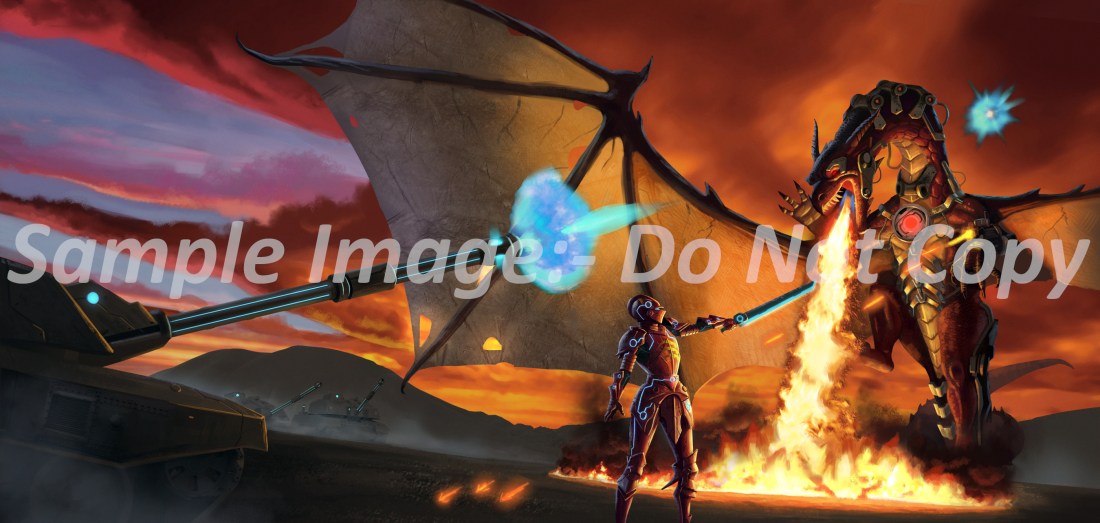
Camelot2050DragonFirePromo

ArtStation is an invaluable resource for self publishers. It’s an online gallery of artists portfolio’s (as well as job listings for Artists). Here you’ll find artists who work in a variety of mediums on canvas and screen and every style you could hope to find from comic the hyper-realistic. The artists themselves rank from the casual hobbyist to concept artists from the film and gaming industry. Via ArtStation you can contact the artist who catch your eye and ask if they’ll do commission work. The important part of this, as much as getting a quality product that fits your requirements, is to have a binding agreement with your artist. You’ll be making a profit based on their work as the cover art is the first thing that will draw a reader to your book. An upfront payment for the piece and making sure the artist is credited (either on the cover or within the book) should secure you the rights to use the work.

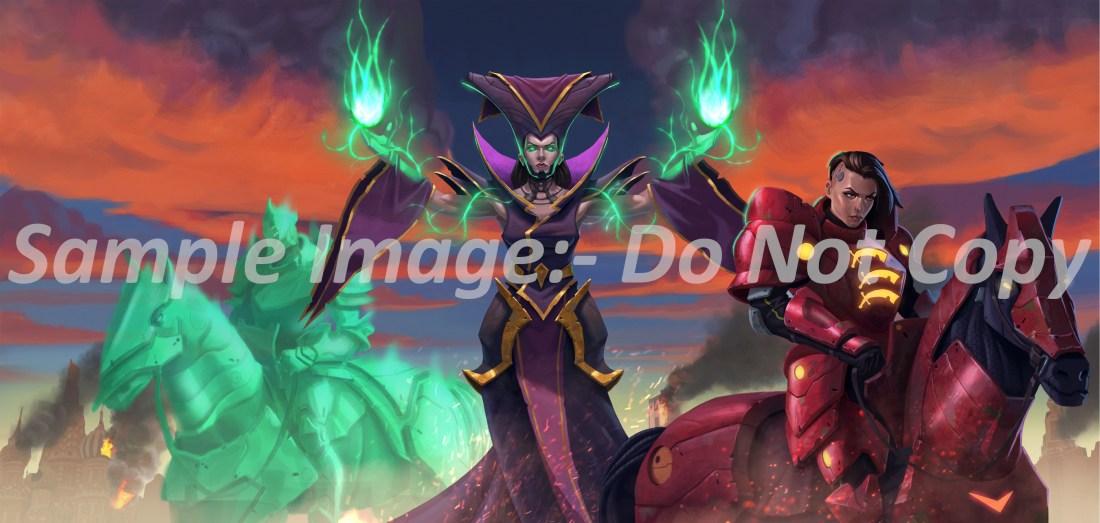
Camelot2050DarkMagicPromo

Another important thing is to find an artist you can work with. Omercan and I conversed quite regularly about what was going on in the piece. After I sent the brief (including dimensions, that’s very important) Omercan came back to me with several layout options, silhouette’s to set the position of the important aspects of the cover image and we went from there. Now I can’t say that that’s how every artist works, artists being as unique in their processes as writers, but it was a good fit for me.

More things to consider at this point are how you’re going to layout the cover. Is the image going to be a band between colour blocks on which you’ll place the title and blurb or are you intending to impose those in the image. If that’s the case you need to make sure that nothing too integral to the image is happening in those areas you intend to put things.

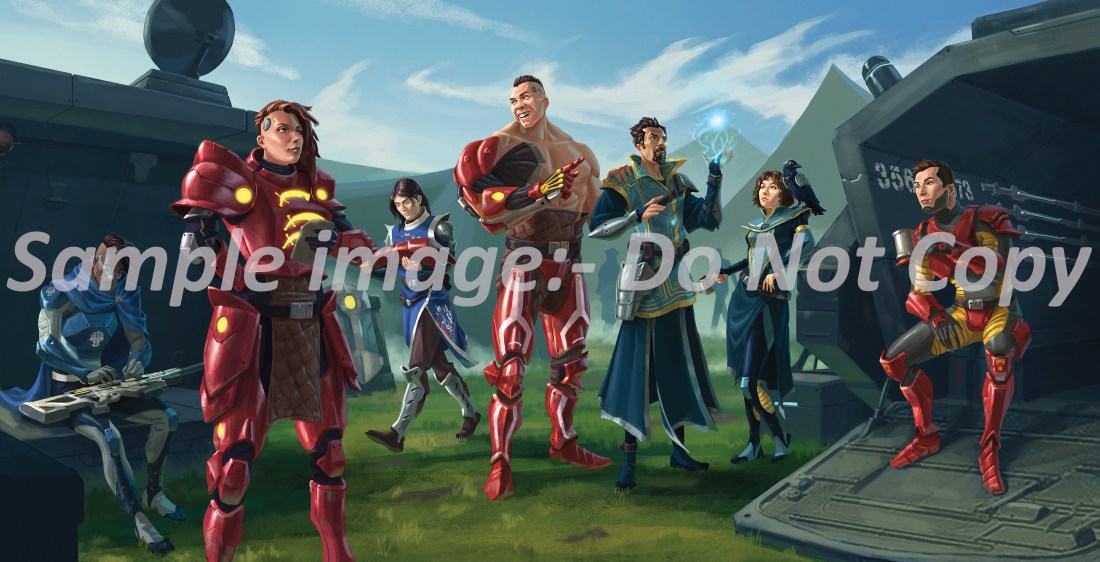
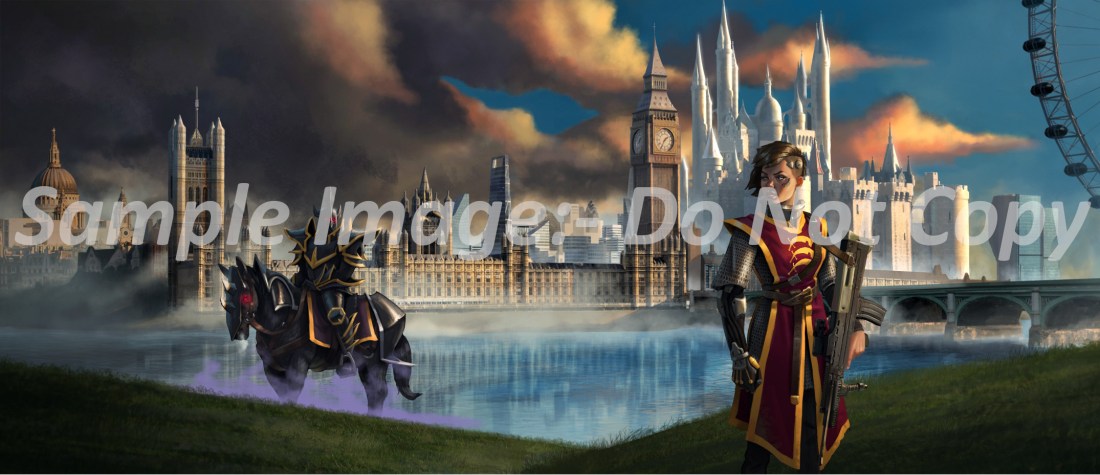
Camelot2050PostcardPromo

Of course, the Artwork you receive doesn’t have to be restricted to the covers of your books. I use Omercan’s art as standing banners to draw people to my tables at conventions, the pieces he does are incredibly hi-res and blow up to large sizes with no loss in quality. I also use the images on my business cards which makes them stand apart too.

In preparation for Worldcon I asked Omercan to produce a piece showing my main cast in a more candid style and a campaign setting. This was for a promotional postcard for the collected sets I’d arranged. Ultimately I credit Omercan for 90% of people who approach my table at conventions (some of them know me already) and a fair percentage of my online sales too. They wouldn’t read the blurb if their eye’s weren’t caught by the art.

So, that was Worldcon Dublin 2019.

Worldcon was an amazing experience, I can’t begin to express my thanks to the organisers, the programme staff, the dealer room liaisons, the attendee’s and new friends I’ve made, and even the Dublin Convention Centre staff who helped over the five days of this convention. Now that it’s done I can go into a bit more depth about my own involvement and what I’m taking away with me from Dublin 2019.

So, having spoken some before about the convention generally I’m going to talk about why I went along. Worldcon wasn’t what I would consider a trade convention like the ShowMasters events in London or the other Film and Comic cons, it was more akin to EasterCon by Ytterbium but on a much larger scale. Worldcon is the annual setting for the Hugo Science Fiction awards and attracts attendee’s, contributors and fans from all over the world. Eastercon attracts around 900 visitors while Worldcon tops out around 5000, so there were a great many opportunities to be had.

As I said I wouldn’t consider it a trade con but I did have a trade table and I was there selling my works because, for a self-publishing author, it is really important to get in point-of-contact sales to get your work into the hands of people who will enjoy it. Having a table is an expense but one that you can hopefully recoup. The dealers room is also a great place to talk to publishers and promote yourself (although you don’t *need* a table yourself to do so). Over the course of the week I have (hopefully) made some ties with a couple of indie publishers which might prove fruitful down the line. I also got a surprise on the first day of the Con when, a few hours after doors open, George R.R. Martin walked past my stall. He didn’t stop to look and I didn’t really want to trouble him so I just let him go on his way, the same applied when Gail Carriger made a brief appearance in the trade hall on the Thursday and, much as I would have liked to have exchanged a few words with her I was engaged with my own customers so maybe some other time.

As well as that I paid for a membership which would allow me, not only to attend the programme items which were of interest but also to take part in the programme itself. I was lucky enough to be asked to sit on two panel items, a discussion of Celtic Mythology, how it has been appropriated and changed over the centuries and how it is represented and influences modern fiction and a discussion on how Creators and Fans respond to Political Unrest.

Not having sat on a panel before the Political Unrest discussion was quite a daunting subject (especially as it was the first item I was offered). Luckily the Celtic Mythology panel was offered to me soon after and, taking place before Political Unrest, would give me a chance to ‘warm up’ as it were. Both panels had their challenges, Celtic Mythology was a very popular talk, full room with three deep standing at the back so quite intimidating for that but with the experienced writers and a resident historian on the panel besides me I like to think the talk was informative and entertaining. Political Unrest was a much more intimate event, smaller audience but with a much greater weight of emotional material to cover. That said I hope I acquitted myself well and at least one of my fellow panelists did stop by my stall later to reassure me that I had.

Besides the panels and the dealers room there where plays and concerts and party’s to attend, people to meet and much fun to be had. Of course there were struggles, although they were limited to factors surrounding the Con rather than attached to. Driving in an unknown city (especially one with as complex a one-way system as Dublin) and issues with my hotel booking are occasionally to be expected when you go abroad or even when you travel within your own country. Any convention, whether as a trader or an attendee will likely have it’s challenges so you just have to roll with it and deal with them as best you can.

I will move forward with my writing forever thankful that I took the opportunity to attend WorldCon Dublin and ever so grateful to the friends I met there and made there and strive toward a time when I can go along, sit on more panels and maybe host a Kaffeeklatch or a Literary Beer (writers hosting small, social gatherings with the attendee’s). It truly has been a life changing experience and really fired my creativity and ambitions.

Paneling at Conventions

Within the next couple of days I will be leaving for Dublin and Worldcon 77 and, not content with selling my books, I have also signed up to the programme schedule. Now that the programme has been released I can, at least, tell you which talks I’ll be sitting in on.

So, on Thursday at 4:00pm I’ll be in the Eccocem Room with Kathryn Sullivan, Dr Kristina Perez, Deirdre Thornton and Kerry Buchanan and we’ll be discussing Celtic Mythology and how faithfully the legends are represented in modern literature and on Friday at 11:30am I’ll be in Odeon 2 with John R. Douglas, Teresa Nielsen Hayden, Michi Troya and Julia Rios and we’ll be discussing how Creators and Fans respond to Political Unrest.

Now, with the shameless plug information shared, why would a self-published writer think themselves an authority worthy of sitting in on panels and sharing their opinions with a room full of fans? Well, at it’s most basic level it *is* about visibility, it’s an opportunity to put yourself in front maybe a hundred prospective customers and make an impression so that they think ‘yeah, this writers books might be worth reading’. It’s also a chance to network and meet others in your field and compare notes (albeit in front of a room full of people). But there’s a deeper connection perhaps, by becoming a writer you’ve essentially declared to the world that ‘I have something to say!’ and, while most of your statements are going to be presented in literary form (and some of us are more than happy for it to stay that way) there are those among us who will revel in the chance to get out there and talk to an audience.

Again, why as a self-published author, is my opinion of any value to these discussions? Well, in any topical discourse there are different levels of awareness to the subject. There are those who might have studied it all their lives and there are those who have just stumbled upon it and many levels of knowledge in between. In regards to Celtic Mythology I personally have a long standing casual interest and, more recently, I have undertaken research as part of paid projects as well as my own research for my own literary efforts. That puts me at maybe ‘passingly familiar’ but, another aspect I’ve looked into which might set me apart from, say a Professor of Celtic Mythology is my interpretation of an audiences understanding. The broader general understanding of any kind of mythology has been influenced over time by different creators portrayals of different original stories and by the adoption of hand picked elements from those stories for new, different purposes. So, by having different experience and different sources I can bring a broader understanding as long as my sources are verified and sound. I will and have been doing additional research before the panel just to cement my foundation of knowledge before the event.

The point is your very individuality makes your opinion valid. If you write crime and mystery then your opinion of how to write such a story makes you as valid to a panel as would be Sir Arthur Conan Doyle’s or Agatha Christie’s it’s the differences of experience that bring vibrancy to a panel. If everyone on the panel agree’s then there is no real, valid discussion, just a bunch of statements of fact.

Another Brief Update (with Pictures!)

So, I might not have gone into a lot of depth over some of the things I’ve been doing in preparation for Dublin Worldcon. This is a big opportunity for me so I’ve taken a few steps to up my game for this event.

First up it’s these:-

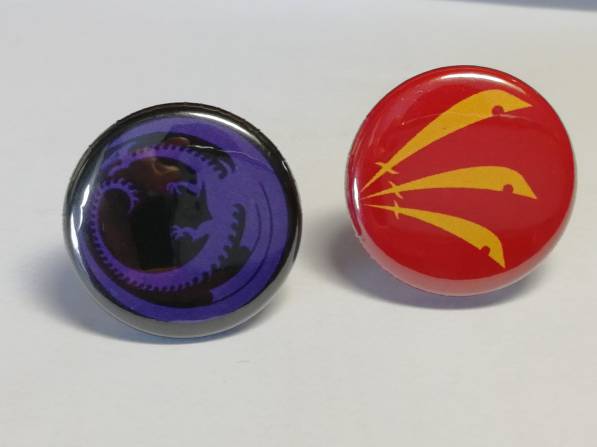
Camelot Badges

25mm pin badges of leFay and Essex Heraldry, the Dragon design is mine (a simple matter of Microsoft Paint) whilst the Essex Seaxes have been redesigned by a good friend of mine (Rob Leigh of Isolation Games) in a more modern style to reflect a sports brand as well as a house heraldry. I have one hundred of each and every purchase of the boxed set gets the pair.

Worldcon Stock

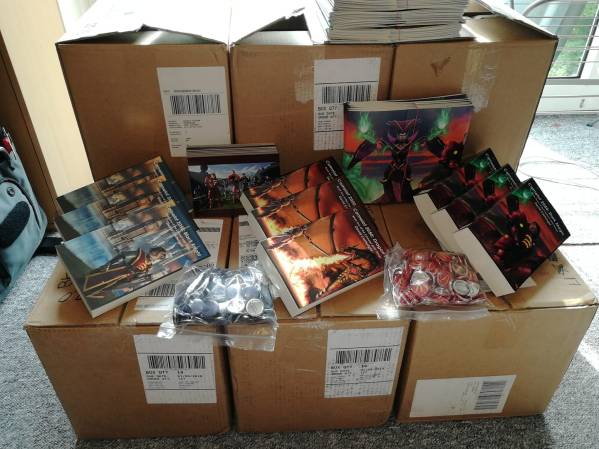
This is the stock as it stands. you can see the books. I’ve got enough to assemble 50 sleeved sets plus an extra bulk of copies of Black Knight for people who just want to try the first book before committing to the trilogy. You can also see the sleeves (graced with the Dark Magic cover art by Omercan Cirit) and the postcard illustrations of the main characters which go into each set, plus the badges.

Box Set 1

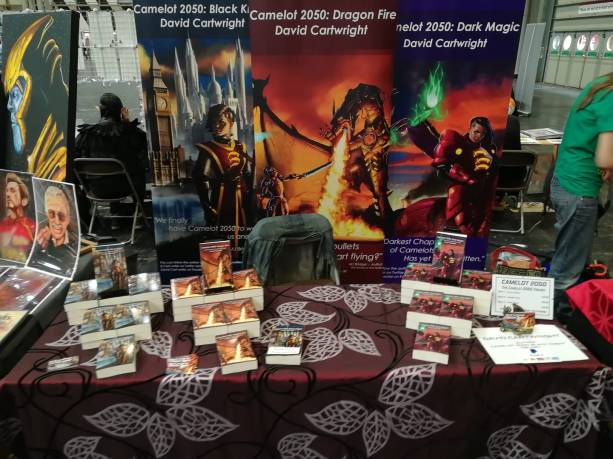
Here’s a better look at the component parts for the sets. Now, all of this is going to go together on a stand setup much like the one I used at Collectormania back in June pictured below.

Stall setup

With all this assembled (and the two panel talks I’m sitting in on) here’s hoping that Worldcon helps me to get Camelot 2050 out there to greater heights and a wider audience.

There’s a World(con) Over the Horizon!

Todays blog is more of an update than anything else to tell you you a bit about what I’m going to be doing at World Con 2019 in Dublin.

I’ve not been one for conventions until I published my own books and started doing the circuit myself so Worldcon didn’t really enter my scope of experience until 2017 when it was held in Helsinki but, bids are held very much in advance so Dublin was already on the cards by that point and an opportunity not to be missed. As much as starting out in conventions was daunting at times Worldcon (A rather prestigious convention with quite a history behind it) is something else. Additional travel, longer stay, more stock and, in order to help promote my series, additional merchandise to appear alongside the books themselves. I will admit it has been stressful at times but I haven’t fallen far short of the goals I set for this event.

*Edit* It occurred to me after I posted this that a little background is in order. Worldcon is the annual event held by the World Science Fiction Society (although it is hosted by different cities every year). The event was first held in New York in 1932 and (except for the years of 1942-1945 for obvious reasons) has run every year since. After travelling city to city in the States for many years Worldcon first went international in 1957 when it came to London, England and since then has been around the globe visiting Heidelburg, Toronto, Melbourne and, has even bee hosted in the Hague in August of 1990. It has also played host to many notables of the Science Fiction, Fantasy and Science community in it’s many years. Robert A. Heinlein in ’41 and ’61, Isaac Asimov in ’55, Arthur C. Clarke in ’56 and Ursula K. Le Guin in ’75. This year, as well as writers, artists and actors the show has Dr’s Jeanette Epps and Norah Pattern in attendance.

Now it’s two weeks to go and my preparations are, by and large, done. So, what can you expect from me at Dublin Worldcon?

Well, I’ll be selling copies of Camelot 2050 for a start and, as well as the usual loose copies I’ll have sleeved sets available, each one with a specially commissioned postcard featuring the main characters and a pair of original pin badges to go with the set (postcards and badges also available separately).

As well as the stall I’ll be on panels Thursday and Friday (although I can’t, at this point divulge which one’s, you’ll have to take a look at the program) so keep an eye out for me. I *can* say that the topics are really exciting and I hope that the talks themselves will be enlightening as well as entertaining.

That’s all I have for you for now, I hope to see you at Worldcon or any of the conventions on my schedule for the coming year. There may or may not be a blog entry next week so keep an eye out. Until then it’s ‘beannachte a dhéanahm anois’ from me!

Originality, is Anything new Anymore?

Anything written today is very likely influenced by those things that have gone before. The invention of Fiction, a genre where both author and reader are aware that the story is the authors invention, emerged in the 12th Century. Prior to that stories which we would consider fantastic, legends and fairy tales and such, would have been considered as truths, moral lessons or histories. We also have to consider that ‘books’ would have been expensive luxury items (the Gutenberg press wouldn’t emerge until the mid 1400’s) and also the influence of the Roman Catholic Church at this time.

So, what ‘original’ stories are there? Lewis Carroll’s ‘Alice in Wonderland’ can be taken as an example, is there anything else like it in the works that came before? I can’t answer that for sure but the only influences I’ve turned up where the societal references for the satirical elements in the book and that has gone on to influence pieces like the Wachowskies ‘Matrix’ films or the Anime ‘Pandora Hearts’ in recent years.

Bram Stoker’s ‘Dracula’ can be said to have been influenced by the historic accounts of Vlad Tepesh and the cultural legends of Vampires from Eastern Europe while Mary Shelly’s ‘Frankenstein’ is influenced by the advances in medical sciences and the study of Galvanism of the time whilst her novel ‘The Last Man’ is an apocalyptic and, between the two, Shelly has to be acknowledged as the founder of the science fiction genre.

Picking up on the cinematic angle, even the most visionary of stories to come out in the last decade have their influences. James Cameron’s ‘Avatar’ and Luc Besson’s ‘Valerian’ (Based on ‘Valérian et Laureline’, Christine and Mézières), even David Mitchell’s ‘Cloud Atlas’ have their influences but, in each case, presented in a new and grand vision.

So, can we achieve anything similar with all that’s gone before? The more important question, surely is ‘Do we need to?’ One of the main elements of a successful story is that it’s accessible to a broad audience and that means they need to be able to identify with at least some elements of it. Putting unfamiliar characters in a familiar setting or familiar characters in an unfamiliar setting and so-on. I’m mostly convinced that, today, if someone were to write a truly original property (in terms of story, characters, settings etc) it would need to be largely unrelatable to the wider readership but, you don’t need to go that far.

Audiences flock to see and read old stories presented in new ways and, to quote an old saying, ‘it’s not about the destination, it’s about the journey.’

Self vs Vanity Publishing.

Some people might be confused as to the difference between the two so this week I’m going to provide a brief overview of the differences and pitfalls a writer can get into if they’re not wary.

So, most of us know that, if we pursue the traditional publishing route it means endless hours of querying. Trying to find the right publisher or agent who see’s the potential of our work. It can be a very wearying experience for most, the waiting and the rejections can take a hefty toll. The other options then are to Self Publish or Vanity Publish.

I’ve spoken at length about Self Publishing, how to do it yourself and what to expect. Whether you go via Amazon, IngramSpark, CreateSpace (who are an Amazon company), DriveThruFiction or any of the other print on demand houses you’ll find various levels of support and services but, at the end of the day, you’re doing most of the work yourself and will have to distribute, or at least raise awareness of your titles, yourself. The upside of this is cost. The file subs and wholesale unit costs are what you pay at the end of the day.

Vanity publishing is something ‘in between’. A Vanity house will publish your work without question and defer a large amount of the initial cost to you so, if you’ve got between £1200 and £7000 pounds to spare it might seem like a good option but, there’s more. Vanity Publishers don’t, as a whole, have the best of reputations and it is important, should you be determined to follow this course, that you do your research and find a ‘reputable’ House. They will want you to sign a contract and it is imperative that you read and understand what you’re signing. Some of these contracts will require you, the author, to buy a certain number of units per year and will put no limit on how soon they can discontinue the work.

The promise for your investment is that the Publisher will get your books on shelves and advertise on your behalf but, oftentimes these services incur additional cost so be wary of that small print too. Beware terms like ‘Hybrid Publisher’ or ‘Partner Publisher’, the business model for this style of publisher (or at least, the immoral ones) is that they make the bulk of their money from the authors who submit to them and do as little as possible with it.

You can read more about the overview of Vanity Press on Wikipedia and there’s a very informative article about some of the particulars and worst offenders on the Writer Beware Blog.