In the Cold Light of Dawn

Well, ‘Happy’ New Year everyone. New Year is traditionally a time for a little introspection, a time to look ahead and make plans for the future. But, I’m tired. I’m not tired of writing, I have a three book contract to live up to and my desire to see my material reach a wider audience still burns bright. I must, however, face up to a single, unyielding, truth.

I cannot attend Chicago Worldcon 2022.

Back when I first decided to go it was pre-Covid, sales at Dublin where good, so good, I was optimistic and eager to go and promote myself and my stories. Then Covid, I held on to the goal of making Chicon22 as a kind of beacon of hope that things would get better. They have not. I’m not even talking about the risk of catching Covid (which I have, so far, avoided like the proverbial plague). Initially I would have taken a budget flight, the cheapest I could find, suffered the 14 hours in the air, ordered stock to be delivered to the venue and, probably, had a great time! But the uncertainty of Covid makes everything so uncertain. If I was refused flight I’d have to soak the costs, I can’t afford that. So, insured tickets? Massively expensive, can’t justify the outlay, even in the January ‘sales’. Even the added costs of the required tests push the budget above and beyond.

So, here’s the thing, the lesson. Events, especially with the impact of Covid and Brexit on footfall, sales and costing, have to be carefully weighed by cost/benefit. Dublin was a massive risk, it paid off and was a great experience. Chicon is and order of magnitude riskier in terms of both financial outlay and potential health impact. The event would have to generate sales to pay for itself and net me a movie deal to balance out the risks, neither of which is a given in the current climate.

So, as of time of writing, I have decided to put plans for Chicago On-Hold and the world seems a little greyer, a little duller for it (although, being an eternal optimist, I haven’t cancelled the hotel, yet).

2023 in Chengdu is out of the question. I hope the team (who seemed absolutely lovely at the Dublin bid parties) intends the event to draw attention to the human rights crimes of the Party but, given the Olympics debacle I don’t hold out much hope. I could go on, but I won’t. Suffice to say it wouldn’t even get to a consideration of costs.

2024 looks more promising, Glasgow running uncontested. That’s the new goal but it’s going to be a slog getting there (2024, not Glasgow). In the interim there will be events but, given what I’ve seen of event attendance so far, I’ll be picking more carefully those events I *do* attend. In the meantime the work goes on, the struggle to get those stories out there and recognised.

… I wonder how I’d go about getting a Camelot 2050 boxed set to Henry Cavill?

A Year in Review, Long Overdue.

My last yearly review was March 2020 so we’re a little overdue a new one and, well a lot has happened since then.

Camelot 2050 continues to gather steam, I have a couple of shorts on the site and may work on more. Eventually they may be gathered into an anthology. Rendered Flesh hit the shelves courtesy of LevelUp Publishing, my first traditionally published title! I have, just in this last week, signed a deal for a three book series, working title Riding the E-Rail , I’ve mentioned it a few times but now it’s really happening!

I’ve completed freelance projects, not only on behalf of Dirty Vortex and Onyx Path, but also for White Wolfs World of Darkness. Yes, my work now features in the Vampire: The Masquerade supplement, Children of the Blood.

The convention scene is getting back up to speed and my calendar is filling up quickly. Events by Showmasters, Go Geek and Creed conventions are largely where you’ll find me as well as Dragonmeet, Bristolcon, Fantasycon, and Chicago World Con 2022.

The Corona virus epidemic and lock-downs have made the past year and change difficult at times and yet, these past few weeks, easing back into events and relative normality (if anything is ever ‘normal’ around here) have been wonderfully refreshing, both emotionally and creatively. I’ve met some wonderful people and made new friends and contacts on the scene.

Aside from the new contract I have a couple of projects on the go but, as with many things, money is key and I will have to find funding or hope for a *very* good sequence of events. There’s certainly a lot to look forward to and even more to do over the coming year, I will be looking at the pro’s and cons of things like crowdfunding and Patreon so watch out for that. In the meantime I will excuse myself for the rest of December and see you all on January when, I hope, the blog will be easier to populate.

Merry Christmas to all, and to all a Goodnight!

Walking with Giants

This weekend just gone by was the Bristol Literature Convention, only the second convention I’ve attended since Lock-Down and I’ll admit, after Fantasycon I was nervous. Not for any real discernible reason, I’ve been to Bristolcon the past three years it’s run as a physical convention and last year as a virtual con. This year, it showed. Previously I have attended to sell my books, attend workshops and appear on panels, occasionally making connections. The selling side never really worked out for me, it’s a better venue for publishers to showcase their stuff. This year I put aside the sales and focused on the other aspects and, whether it’s because we’re all desperate to make new connections post Lock-Down, or because I’ve been going a few years and my face is known now, it seemed like a curtain was lifted and a whole new world spread out before me, a land populated with literary giants!

A quick side-bar, I hate the term ‘literary’ when talking about figures on the writing circuit. It makes some people seem more ‘highbrow’ (and I dislike that term for its eugenicist origins) or intellectual, it’s elitism and I hate that idea that, although we’re all writers, some of us are ‘better’ for some reason that vaguely equates to ‘I’m smarter than you’. But, that leads into a pretty good con story.

A few years back my partner/editor came with me to Bristolcon and watched a panel with then Guest of Honour, New York Times Best-Selling Author, Jasper Fforde. I’d recently taken a hit to my confidence from some very critical, nay cruel, Amazon reviews and was questioning going forward as a writer. In the panel the question was raised as to how to deal with criticism. Jasper’s reply was absolutely spot on, ‘Don’t read it’. It’s pretty much where I draw my rule one ‘Thou Shalt Not Read The Reviews’ from. At that point my partner was determined that I would meet Jasper Fforde. Fast-forward to this year and we signed up to a workshop, given by Jasper, about ‘Your flagging, non-career in writing’. It was an eye opening piece about how, having achieved the status of a Best-Selling Author, Jasper was struggling to recreate that initial success. He posited the question ‘Who here feels qualified as a writer?’ no-one raised a hand, whatever the level of education (myself sitting on a meagre GCSE English and a GNVQ in Media studies) the overall feeling in the room (which also hosted the winner of this years BFA Award for best fiction) was of impostor syndrome. Of course, prior to the workshop I had, encouraged by my partner, sat with Jasper in the hotel lounge telling him all about how he saved my fledgling career. We talked for about half an hour before the workshop about politics, life, projects and it was amazing! Coming out of the workshop, headed back into the con, my partner announced that this was a goal achieved, four years in the making, to get me sat down with Jasper Fforde. A wry voice from behind asked “And how did that work out?” and there’s the man himself, following us up the stairs.

This year at Bristolcon I paneled down the table from Jasper, siting next to the indomitable Anna Smith Spark, the Queen of Grimdark Epic Fantasy. I will freely admit that, over the years of seeing Anna glide effortlessly through conventions in her amazing array of heels, I have been (and still am to an extent) massively intimidated by her comportment and poise but, having sat and chatted briefly on panel I can confidently say she is a lovely person whom I’m sure will be gracing the circuit for years to come.

Another very intimidating figure whom I’ve been reluctant to approach in the past (not-so-much because I’m not familiar with his ever-so-popular works but because of his amazingly terrifying eyebrows) was Adrian Tchaikovsky. This year, having moderated a panel featuring himself, the irascible Jaine Fenn, Kevlin Henney and Susie Williamson I found myself, that evening sat at the same table as Adrian, Gareth Powell, J. Dianne Dotson, and Allen Stroud whom (I discovered at Fantasycon) had been editing much of my freelance work.

Now, it might seem like I’m name-dropping and, to be fair, I am. There are famous authors and there are well-known authors and it’s important to remember that, under the hype, we’re all just people who wanted to tell stories. As Jasper said;

“You Don’t Learn Writing. You Discover your Vocation.” – Jasper Fforde

And there I was, at the Hilton Doubletree for a day, surrounded by other people who discovered the same vocation as me, as us, and they were’t imposing, or aloof or any ‘better’ (in a purely objective sense). They were wonderful and welcoming, funny and fallible. I’d recently seen a tweet from an aspiring author saying that they’d been advised to join Twitter to find ‘their people’, that they’d only found other authors and since we were all ‘the competition’ this author was quitting Twitter. But we’re not competition, we are a community. We talk about other works than our own, we recommend other authors books, we support each other when we struggle. My last blog spoke about how singularly isolating writing can be and, in process, it can be. But you go out there to talk about your stuff and you’ll find a whole community eager to listen.

Broaden Your Scope

To date the blog posts have discussed mostly aspects of writing, the how and why’s of creating a narrative or a product. I’ve also delved into events, how to prepare and go about running a stall and getting on the program. But that’s not the be-all and end all of getting yourself out there. There are a couple of things I have done (or hope to do/am about to do) that can aid your visibility as an author/personality and, once people know your name, they are more likely to buy your work. This article is going to talk about some of the ‘other’ opportunities that have arisen for me during my time on the event circuit and avenues that I intend to pursue to increase my visibility as an author.

Social Media; Now, I have discussed this before. Back at the beginning I met an editor who espoused the opinion that both publishers and editors want you show that you are prepared to do the work promoting yourself. I have since met people in the industry who have different views but, the key thing is, it doesn’t hurt to do it anyway. Whether and agent or publisher want you to have a pre-existing online footprint or not, they’re not going to mind if you do. The only way it can hurt is if you’re actively alienating broad swathes of the target audience/demographic, or straight up being offensive/bigoted toward others. Most reputable publishing houses want nothing to do with that kind of drama.

Vlogging; Video-Blogging, now I’m not about to start a channel, the powers know I struggle enough just maintaining this blog and my other social media sites. What I’m talking about is doing interviews and speaking about things that you are passionate about on other people’s channels. You can’t just approach a vlogger and say ‘Here, talk about this!’… well, you can but I doubt the success rate is going to be high. My first interview occurred when I donated a set of my books for a charity auction. The auction was going to be held as a live event on YouTube so the crew wanted material to pad out the run so they interviewed anyone who donated stuff. More recently I took part in a charity event and just got chatting to the guy who was recording the event, in the end he offered to do a review and I passed him a book. Remember, while some people who buy your work will review as a matter of course, be prepared to give books away, it won’t always result in a review, but it can be written off as a ‘promotional expense’ for tax purposes. Most recently, as a result of a panel item at Fantasycon, I was approached by a vlogger looking to do a piece on the topic we discussed at the panel. It’s yet another bonus of getting on the programme circuit.

Industry Publications; Now this one came to my attention just recently. There is nothing stopping you from submitting articles to industry magazines, both print and electronic. As well as the short-story publications there are a number of genre specific magazines and web sites catering to Sci-Fi, Fantasy, Horror, Romance and every other genre. The British Science Fiction Association itself prints four titles covering interviews, reviews, tips of the trade and short fiction. They’re always looking for material and they’re just a quick web-search away

Why Do We Self-Pub?

So, a couple weeks ago I was at FantasyCon (as reported in my last Blog) and, while I was there I took the opportunity to sit in on a couple of panels, the majority of which were great. Honestly, event panels can be a great insight into the hows and whys of the industry, but there can be exceptions.

The panel in question was about Self-Publishing and, I gotta say, I found it to be soulless. One panellist kept regurgitating the opinion that you should ‘Find out who you’re like’ and market yourself on that basis. Another panellist actually voiced the opinions that you should ‘Find a groove (re: Genre) and stick to it’, and that you should ‘Research what the audience is reading and write that’.

Like I said, soulless, might as well write for Barnes and Noble. I walked out of that panel.

The opportunity of Self-Pub is to break the molds, buck the trends and get outside the industry boxes, to write what you want, how you want and to go out and find the audience who will appreciate it for what it is intended to be. Camelot 2050 would never have been published traditionally (although it may still get published retroactively). A trilogy by an unknown author is unlikely to be picked up, nevermind how novel the concept might be. So how do you increase you chances with your new property?

It’s all in the basics, Pay attention to sentence structure, keep it concise, keep the prose punchy and engaging. Polish the dialogue, keep it clean and clear (unless it’s meant to ramble). Pacing, the story to move forward, whether it’s fast-paced action or slow-burn thriller. Edit, edit and edit again, errors will sneak through but the more you catch, the better off you are. Study industry layouts and avoid ‘flowery’ fonts. Make your story amazing, but make it easy for the audience to digest by keeping layout and typsetting familiar. Package your wonderful, eccentric or out-there novel in an easily recogniseable parcel and let it speak for itself.

There are tools around for self-promotion, Facebook ads, pay-review sites and, if you can afford that marketing, then go ahead, absolutely, but be sure. Check the reviews and don’t be scammed, your best friend there is TrustPilot. Look around, read around, find an approach that works for you, you might be prepared to dial back your voice to ‘fit’ with what the industry is printing to encourage sales, or you might have the confidence to blaze your own trail and stand by your work regardless. At the end of the day, neither is a surefire path to success, there are so many books out there but, what you can be certain of is that readers will keep reading. You have to get your work in front of them the best you can and, if they enjoy it, isn’t that enough?

We’re Back! (Buts, Buts and More Buts)

I said last time that I was going to try and come back to the blog more frequently but then… yeah, I dropped off the face of the earth yet again. But that was before, before the British Fantasy Societies FantasyCon 2021!

Yes! This weekend past I attended a convention! My first for nearly two years! I paneled, I moderated, I did readings. I. Met. People!

Here it gets tricky, there’s the feeling that there should be a ‘but’ here and there is ‘but’, the emphasis of that ‘but’ falls squarely on the situation surrounding where we presently find ourselves rather than the con organisers. The ‘but’ is also informed by my preconceptions, my over-excitement at getting back out there. All credit to Allen Stroud and his team, the con was great, the location well-chosen and the programme diverse and engaging and, had the con tailored to five-hundred guests or more it would have been amazing (and here comes that ‘but’ again), but. Covid.

Fantasy Con presented to somewhere between two-hundred and fifty and three-hundred people, a perfectly responsible number. In my eagerness, my excitement, I kind of forgot about Covid for a bit, despite my mask, despite hand sanitiser and not hugging or hand-shaking, the precautions remained but I was less aware of them. Which meant that, I was briefly disappointed by the low turnout, the audiences of two or three people for talks or readings, the low-flow in the dealers room, but here comes another but, but those people who did attend, brought an energy with them. They brought a different kind of infection and it was good. We talked, we drank some, we joked and even did karaoke (which I’ll admit, led to many new introductions) and, long before the end of the Con, the numbers for the turnout didn’t matter so much. I mean, if I were to look at it as strictly a cost/benefit analysis in terms of profit? It was a significant loss, but! There were new connections and contacts made, new opportunities prevented and I came away with new friends. And that is most definitely more important in the long-run.

So, for a weekend I almost got to forget that the past year-and-a-half had even happened. The ball has started rolling again and I have new experiences to share with you. As ever I share these ongoing experiences in the hopes that they help you find your way in the world of publishing and self-publishing. Writing doesn’t happen in a vacuum and neither does building your audience as an author. Just as you put your work out into the world you can benefit from putting yourself out there too. It’s not going to be easy going ahead, Covid is still with us but we have precautions we can take, steps that we can observe to make ourselves safer so that we can, if not cast the fear off entirely, lessen its hold over us.

But (and it’s the last ‘but’) the world turns, we have stories inside us and the audience demands we get them out there. Who are we, the writers, authors and story-tellers, to say to them ‘But?’

Back from Hiatus.

I’m back! I hope. I may’ve mentioned a couple of times that coming up with content for these blogs is particularly hard when when there’s very little going on. It’s not just Covid and the lock-downs but I’m in editing right now which is a fairly simple, read, revise, rinse, repeat system, but!

Since LevelUp published ‘Rendered Flesh’ that has given me an ‘in’ for my next book ‘Riding the E-Rail’. As with many small press or specialist labels LevelUp is part of a publishing house Ockham and , while E-rail doesn’t suit LevelUp’s publishing Identity there’s a chance that it will fit with one of the other labels. In the meantime I though I might revisit submissions and querying since I might be doing that soon anyway and it’s always good to be prepared.

And, preparation is key. Whether you are looking for an agent, or a publisher you want to submit to a body who actually promotes/publishes what you’re writing/have written. There are numerous directories of publishers that you can get access to either in physical print or by web-search. The printed directories are reprinted yearly so it’s probably best to request the latest one from your local library. Searching agents and publishers online by genre is a time-saver and, conveniently, there are blogs that list agents who are open to submissions (but check the timestamp on the article and follow the link to the agents page to make sure that’s still the case). There are also Hashtags on Twitter you can follow, #MSWL stands for ‘Manuscript Wish List’ and is used by agents to source authors writing manuscripts they want to represent. Of course, people being people, it’s also attached to Tweets from writers touting their latest unpublished work so it can be a bit of a slog to find a relevant message. The idea being that a writer with a compatible piece should reply, or DM the agent in question.

A simple search of ‘Agents seeking new Authors 2021‘ led me to this blog, in the top 3 search results, from which I’ve identified eight suitable agents that I could submit E-Rail to. Now, in this electronic age, some agents and publishers have online forms where you can outline your piece, whether it’s a finished draft or still a concept but, more often than not, they require a formal submission or ‘query’ in a set format. There are slight variations from publisher to publisher but they all feature the same three stages.

1: The cover letter. This is your ‘elevator pitch’, it should include a brief bio of yourself, including published works to date, and a very brief synopsis of your story.

2: The Synopsis. Unlike the pitch in your cover letter the synopsis here ought to cover all the key narrative elements of your story. This isn’t a sales pitch per-se but ought to be a clear outlay of the story and any twists or turns in the plot. You’re not hiding anything ‘for the audience’, this is professional.

3: The Sample Chapters: This usually fall between the first 30 pages or the first 3 chapters. Point to note, use a standard font (Times New Roman or Helvetica/Calibri, size 12, double-spaced). Again, there can be variances between publishers so check the in-house guidelines before you submit.

Always check the submission guidelines and tailor the package, if you don’t then your submission won’t even be read in full. It’ll end up in the ‘Slush Pile’ (aka ‘the bin’). Oh, it might get glanced at, in a couple years, on a slow day, when the agent has nothing better to do, maybe.

Querying is not a quick turn around. When an agent opens their doors to submissions they will be inundated. The guide above should ensure that your pack is, at least, read in the most part but it’s no guarantee. *If* the agent likes your submission it can be six weeks before they get back to you at least. Querying is an endurance test, unless you’re very lucky you’ll get a pile of rejections before you get that request for a full manuscript. My suggestion is to search for 5/6 agents/publishers to submit to every two weeks. A very important thing to remember is that, being in the industry together, many literary agents/editors know each other. You may consider the industry lucky to receive even the offer to print your masterpiece, the very idea of a rejection may be anathema to the public good who will lose out from not having read your work. When you get that rejection, take it in good grace. I’ve heard of authors hitting back against publishing bodies who rejected their work in just the manner I outlined above. I heard about it from Publishers and Editors at Literary Conventions. It doesn’t benefit you as an author, or improve your chances of getting published anywhere so, take a breath, accept the decision, and move onto the next. The most important thing an agent can bring to the table is belief in the quality of your work. That’s the goal, that’s what you need, accept nothing less.

Money for Nothing?

A couple of years ago now I was asked to go to my son’s primary school and talk to the book club about ‘Being a Writer’. Imposter syndrome aside it was a rewarding experience but, as is the way of children, one insightful little monster cut right to the heart of the matter in the questions section at the end.

“How much money do you make?”

Now, it’s often joked about that writers don’t make much money but it’s not really something that’s talked about in depth for those just starting out so, though it may be gauche, Let’s talk about Money.

Now, self-pub is gonna cost you before it starts making money, let’s talk about costs. If you want your work to be available to readers through shops, most online retailers, and even libraries, you’ll need an ISBN or ‘International Standard Book Number’. This is a catalogue number that allows vendors to identify your book. You don’t need one to self-pub E-Books on Amazon, but you do need to resign yourself to the fact that it won’t go any further than that platform without one*. A book ISBN is also used to generate the barcode which carries the books details, they retail from Nielsen’s at £89 each (there are job-lot discounts available). Remember, your ISBN is linked not just to the book, but the format. Releasing in softback, hardback and Ebook? That’ll be three ISBN’s.

Next come print costs. Amazon will put your work on it’s e-platform and print-on-demand service with no file upload costs, it’ll take the cost of hosting directly from your sales and your work won’t be available on the likes of Apple Books, Waterstones or Barnes and Noble. Another factor to consider is the amount of complaints I’ve come across about their overall print quality, from the cut, to the ink running and smudging. As with many things, the quality of your product costs. I’ve mentioned before that I use IngramSpark, I pay $25 dollars each to upload my cover, internals and my eBook format, then I order fifty units for my own stock upon approval and get the file uploads for hardcopy ($50) back. I have had it recommended to me that CreateSpace is the printing house to use for cheaper copies for retail yourself but that’s all you get, there’s no distribution, no e-platform service.

So, already you’ve laid out quite a stack of bills and you’re looking for returns. Well, let’s talk about pricing. Amazon offers a 70% royalties plan, surprise, surprise there’s a whole mess of hoops to jump through and it’s limited largely to the western, English-speaking world. More likely you’ll be subscribing to the 30% royalties plan for ease. So, for a $3 book you’ll be earning less than a dollar. Sounds good right? Remember that your royalties will only be paid once you reach the ‘Remittance Threshhold’ of $100 and you’ll receive that no sooner than sixty days after the sale of the last book.

It’s worth noting here that Ebook and face-to-face sales are where you’re going to make money initially. Brexit really did a number on my pricing for the Camelot series, I used to make 45p per hardcopy sold online (which is more than big pub pay authors, but they make up for it in volume of sales), now I sell online at break-even in the UK and have had to instigate a slight rise oversea’s for any kind of profit margin. Of course, I can still buy my units at cost from Ingram and sell at the list price (except I can’t until Covid Restrictions ease). Ingram will show you, as you price, how much you’ll get in compensation. On Ebooks the margin is about 20% so, as I say, that’s where you make some back.

Of course we’re *hopefully* approaching the end of Covid restrictions, and we’ll be vaccinated soon to the point where ‘Herd Immunity’ can be properly applied as a principal. Selling at events is fun and I highly recommend it. I’ve been to events where I covered Table Cost and expenses with a couple of sales (a small, local con I could walk to that charged a tenner a table). Likewise I’ve sunk some money into conventions, hotels and travel and not nearly made it back. Depending on what you want from being an author it’s often worthwhile taking a risk. Literary Conventions will see you put up stall in a room full of book sellers, if your products good and you sell well it can be worth it, but those are big ‘If’s’. Sci-Fi, Fantasy and Film con’s are a good bet because a large percentage of the footfall are readers as well as fans. My biggest cost/reward return was Worldcon. I went to Dublin, it was a massive outlay but it paid for itself and, with it being a Literary Con, I met some great people, got some good exposure (which I wasn’t paying for/being paid in) and even picked up the Rendered Flesh project into the bargain. I’m going to Chicago next year on the strength of Dublin sales.

Of course, if you’re lucky you’ll be able to pick up freelancing projects to subsidies your own projects. Now Freelance pays by the word, not the hour or the page. You’ll more than likely have a fixed word-count too. I’ve been lucky enough to enjoy rates of three to five cents on the word for projects ranging between two-thousand and ten-thousand words. Getting paid for your work is a wonderful feeling. I mentioned ‘exposure’ earlier, the recent rallying of creatives against ‘working for exposure’ is a wonderful thing to stop big companies trying to get away without paying artists. It’s a scam and you shouldn’t ever accept it from them. However, as a personal opinion, I *will* work for exposure when the person, or persons I’m working for is a struggling creative like myself. By working in concert we as creatives can expose the others audience to our work and maybe pick up some more followers. I’ll let slip here that I’m currently staring down the barrel of a joint project with a particularly notorious creative individual, although I can’t say anymore than that.

Of course I’m not supporting myself, not even close. I enjoy a living arrangement that allows me to pursue writing as a career. The likelihood is that most of you will be supporting yourselves, funding your writing with your day jobs and, should you choose, attending cons alongside those jobs too. I empathise, I haven’t done the two things side-by-side but I was introduced to the con scene by someone who did and I’ve seen the effort that they put in. Although, I *did* make a profit fro my tax return last year (mostly because I haven’t been anywhere and all the events have carried my table costs over from last year. Anyway, still holding out hopes for the Netflix deal but, until then; writers don’t get rich, we enrich the lives of our readers.

Making a total Hash-tag of it!

Getting these blogs out during lockdown is proving something of a challenge I’ll admit! I know I said, back at the beginning, that they’d be ‘as and when’ but I was hoping to do one a week at least. The reality of it is, without new experiences to share I flounder for content, I don’t want to rehash the old but I have to *do* something new to *post* about something new!

That said I’m about to embark on a quest to find representation but, before I blog about the ‘search for an agent’ (complete with witty word-play title), I wanted to talk to you about an aspect of writing that both agents and publishers are looking for these days, social media presence. I mean, sure, you could try the ‘mysterious reclusive hermit’ approach but, in this day and age, you have to be seriously talented to get a book published purely on its merits because these days, part of the ‘product’ is you.

Publishers and Agents want to know that you can sell yourself to draw people into your works and that meant having a Social Media Following. Facebook, WordPress, Twitter these are all tools for a writer or any creative to generate publicity and interest. Of course just throwing up tweets isn’t the be-all and end-all, there are other tools that you need to learn to use, one of those being; Hashtags.

For the uninitiated a #Hashtag is simply that, you prefix the word (or words) with a hash symbol and voila! Your post is now labelled with an easy peasy search term. ‘But how will I know what to hashtag?’ You might ask, well. That’s what this blog is about.

#WritingCommunity – that’s the big one, if you drop this tag you’re addressing all of us. This Hashtag targets the community.

#Iamwriting/#Iamediting/#Iamrevising/#WIP – these three are all about you happily getting along with what you’re doing, wordcounts, finishing chapters, editing and revising a finished draft etc.

#Writerslife – a Hashtag for pictures of your cat interfering with your progress, work in the garden, you’re latest culinary creation. All those little and uplifting things that surround writing, or the troubles and tribulations associated with it.

#NaNoWriMo – You know it, I loathe it, National Novel Writers Month, if you’re doing it, talk about it.

#PitMad – this one I’ll go into more detail with in another update but PitMad is a Twitter event for writers to pitch their works to publishers and agents. There are some rules involved so read up about the when and how.

#(YourGenreHere) – Tag your work by the genre you’re writing in, you’ll draw interest from other authors, readers and, maybe that Publisher you’re looking for.

This list is by no means exhaustive, there are many more from #WriterLift to #SaturdayShoutout, if you want to find out about more hashtags you can use there’s a useful blog here.

Anyway, if you’re proud of your work, shout about it, post about it, Tweet about it and uplift it. Get it out in the world and let others uplift it too.

Rules of Engagement (Dealing with Criticism).

It’s been a *long* time since I discussed criticism and engaging with it. I still hold the view of ‘Thou Shalt Not Read the Reviews’ but I think it’s time to explore the subject in a bit more depth, given that I have a little more experience with it now than I did then.

My first post on the subject was light on actual anecdotal evidence, as I said then, talking about/engaging with criticism leaves you open to more criticism. I’m not James Blunt, responding to mean Tweets with pithy comebacks and cool detachment, but I’m going to share a couple of instances and my thoughts around them. I’ll not identify anyone, and not just because I don’t know actual identities but because the purpose of this post is not to shame critics but help you address the way you think about any criticism you receive.

Back at the beginning I released Camelot 2050: Black Knight and, to coincide with it becoming available online (bear in mind I didn’t publish via Amazon, I’ll come back to that) I booked a trade table at an event that same weekend. It was a small affair, a fantasy convention in a school sports hall run by someone I knew through LARP. It was a good weekend, I saw some friends, sold some books, packed up with me partner and we headed home. During the drive I pulled up my new Amazon listing, two reviews, both One-Star. I read them, I was hurt and angry. During the three-hour drive home I was bolstered by the righteous outrage of my partner and urged not to reply. I stewed for a while but, in checking the profiles of the ‘reviewers’ it turned out one had never reviewed anything else, and the other was a fan of erotica (90% of their other reviews where erotic fiction, perhaps a case of a mistaken purchase).

I can’t say for sure if those reviews were genuine disgruntlement, personal attacks or, (as I have often entertained) posts from some Amazon-owned troll-farm designed to put people off Indi Writers who don’t publish via Amazon itself. What I can say is, within a few more days I had a slew of Four and Five-Star reviews behind me and I felt a good deal better about the whole affair. Later that year I was at a convention and a professional editor commented, on-panel, that they wouldn’t read any book that had all Five-Star reviews. They’d read a book with a slew of One and Five Star reviews, they said they’d read the shit out of it to find out what the contention was all about. Again, as a lecturer of mine stated, Media is about provoking a reaction, whether it’s ‘good’ or ‘bad’, as long as it isn’t indifferent.

I can tell you what else those Amazon reviews weren’t, they weren’t the people who came up to me at convention around the UK to tell me how much they enjoyed the book and could they have the next one, please? They weren’t the one reader at a London con who bought the first book mid-morning and came back about 2 o’clock to buy the whole series.

Since that weekend I’ve completed the Camelot and a couple of shorts, I’ve written under contract for known and highly-popular RPG titles and the project leaders have come back and asked me to do it again. Most Amazon reviews aren’t event reviews, they aren’t critiques, they’re opinions and people have a right to share them. You have an equal right to ignore them. An Amazon Review isn’t an editors critique, those should already have happened, and in confidentiality and, having been edited I can share that a good editor will point out the stronger sections, to encourage them, as well as the points they feel could be reworded/worked to improve the whole.

I’m going to share a more recent account, not strictly linked to any of my works but it’s an example nonetheless.

Back Story: A writer I may be but anyone close to me who has read the raw draft will agree that my command of grammar (although much improved from way back) is still akin to someone loading punctuation int a scatter-gun and firing it at the page. Also my fingers sometimes struggle to keep up with my mind, so typo’s are common and *that* translates to my social media postings. This led to a meme, I took the Colossus ‘Moments’ speech from ‘DeadPool’ (2016) and switched out ‘Hero’ with ‘Author’.
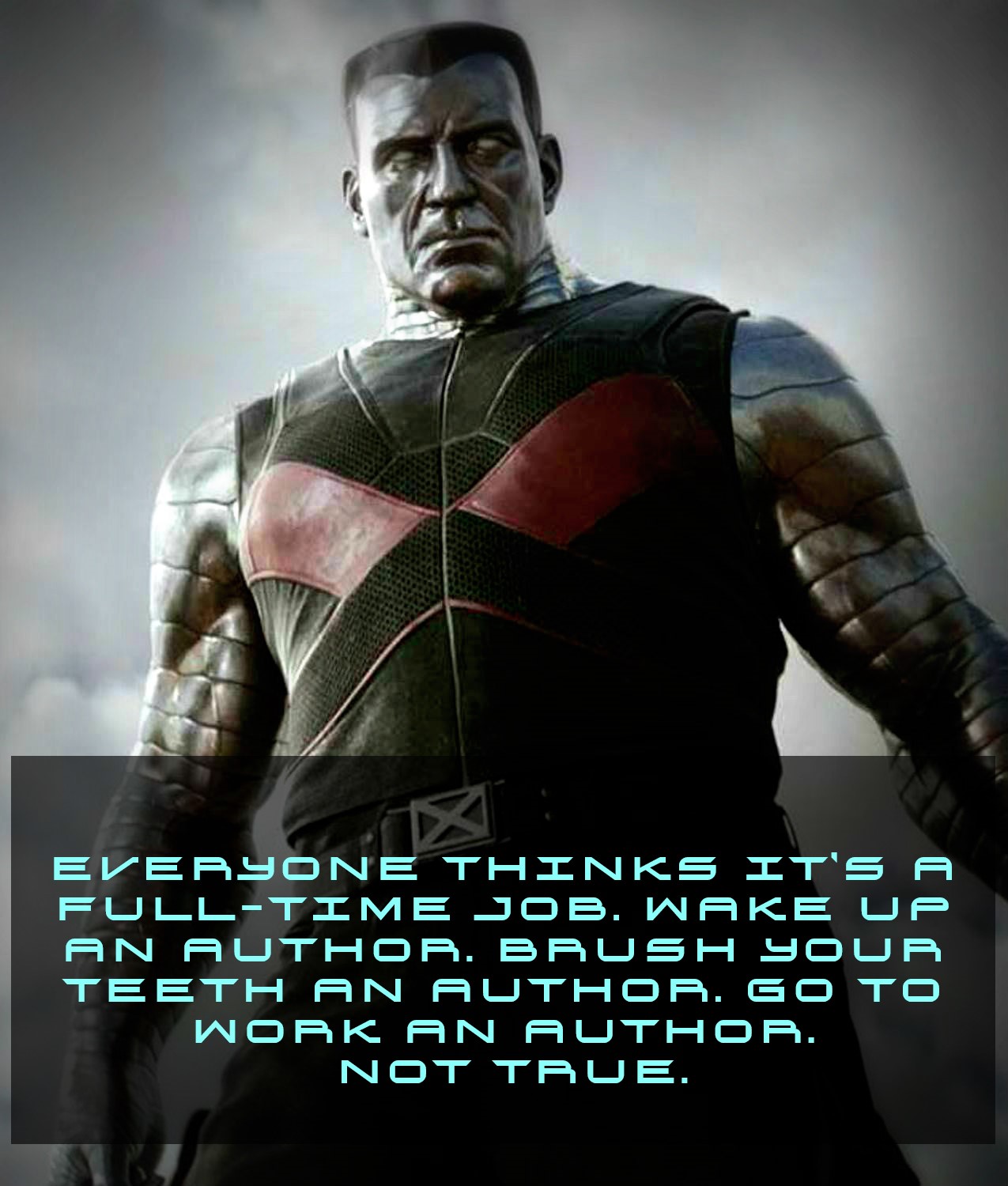
I figure other writers would get a chuckle from it so I shared it to a writers group I’m a part of and, low and behold, a comment.

“Wouldnt know, I cant read the font and the color is horrible lol”

This, right here, is a perfect example of an opinion as opposed to a review. The poster has identified what they don’t like (font and colour) and focused on that. They *don’t* know that I created this (and that I’m not a graphic designer) so they perhaps don’t realise that this could be read as kinda mean (under the current climate with everyone struggling so much), they’ve just dropped their immediate thoughts and carried on about their day. They haven’t contributed to a discussion or even taken in the message.

Yes, this is recent. Yes, I’m still mentally formulating comebacks for ‘the Meme Critique’ but, that’s the same mindset I employ to my dialogue and prose, it’s what leads me to go back a rewrite, to sculpt and craft those lines. The very thing that causes me to fixate on criticism is the same thing I rely on the help me write the best, most compelling stories that I can. The difference is this, after a few days I’ll leave the ‘criticism’ behind but I’ll go back to my WiP again and again until it’s perfect (re: ‘Good Enough For Release’). We can learn to leave that negativity behind, none of us need to be carrying anymore of it around than we have to and, as creatives, we are going to draw criticism at some time, from some sector.

I know my work is good, I live with my biggest fan, I’m surrounded (at a socially responsible distance) by people who do like my work and, hey, I’m about to be published. So don’t let a little negativity, a few voices in the void (or on Amazon) get you down. Stick with it, be kind to yourself (and others) and you’ll get there.