Editing and Layout Revisited.

Because it is quite an important subject I thought I’d come back to editing and layout. Now, I’m repeatedly told that my grasp of grammar is wildly imperfect and I can’t disagree with that. My approach has been likened to writing a page of prose, filling a scatter-gun with punctuation and letting the poor words have it at close range. Again, not going to argue since the only qualification in English Language I have is my GCSE grade (and I’m not telling what that was). Now, many will advise you to pay out for a professional editor but I understand the pinch. Editors aren’t cheap, nor should they be however, most of us know someone with a better command of such subjects than our own. As I mentioned previously an Alpha Reader ought to be someone you know and whose opinion you trust and, just for a benefit, knows grammar better than you do (spelling isn’t so much of an issue what with spell checker functions and all). If you don’t think you know such a person then I can recommend ‘My Grammar and I’ by Taggart and Wines or, ‘Eats, Shoots and Leaves’ by Lynne Truss. Either of these books can guide you through correct punctuation.

Also look out for ‘passive voice’. It’s just as it sounds and readers don’t want fiction to be ‘passive’, they want to be engaged, they want a sense of urgency. The easiest way to combat is to write as if it’s all happening right then, right there because, for the reader, it is. Even a flashback should be treated like a current event, the first run through. It’s qualified as ‘Subject’ + ‘Verb+to be’ + ‘Past Participle’. There are plenty of articles explaining it better and most of the examples I’ve found come across as really clunky but the root of it it, in passive voice something it done to the subject, in active voice the subject does something. It’s worth reading up on it.

Editing aside let’s review layout. If you’ve written your manuscript the traditional way it will be double-spaced to help with editing but don’t leave it like that when you transfer it for layout. For a start it’s unnecessary, all it does is expand your page-count and your costs. One of the first things you’ll want to do is set a page size. Look over your chosen publishers range, choose one that you’re happy with, personally I publish at 7″x 4 1/4″ but it’s quite a pricey option. I see a lot of 8″x 5″ these days at shows and it’s one I might consider if E-Rail runs much over 100k words. Once you’ve chosen page size set your margins (because Word won’t alter them) you want a mirrored setting because your outer page margin will be about 1.3cm and the inner (or spine) margin sets at 1.5cm to allow for binding. Top and bottom margins usually set at 1.3cm too.

Headers and Footers are of use. A footer for your page number, starting on the first page of the actual story, not the first page in the book, is a basic requirement (though I haven’t yet discovered how to mirror those, mine are always in the lower right corner much to my embarrassment) and some publishers use the header for the book title on one page and the authors name on the other. Once I discover the secrets to this sorcery I’ll let you know.

As I’ve covered before the initial page structure I’ve found most commonly is;

  • Writer Bio, facing side of the first page.
  • Blank or ‘Also by:’ on the rear of that page.
  • Title Page (including Authors name and publisher – facing)
  • Legalese – published by, statement of copyrite and ISBN (rear)
  • Forward (if you’re indulging in one – facing)
  • Title Page (title only – facing)
  • Story

With that arranged you can import your manuscript and get it laid out. First note, tabbing. Every time you hit return you’ll want to tab in. Most word processor programs set a default tab of about an inch but you won’t want that much. Reset tabs to a half inch at most. Hit return when a new character starts speaking, A new scene comes up for description, when it feels right to do so. You, like me, have read many books I’m sure. You’ll pick up the queue’s of when to hit ‘return’ in your manuscript. But, unlike most other documents, don’t drop a line after a paragraph. Only add a break after a change of scene or a passage of time.

All Chapters (should you use them) should start on a facing page (an odd numbered page). At point’s you might find you have a blank side, an only partly-filled side or, horror of horrors, a partly blank facing page with an entirely blank rear page before a new chapter. There are two ways to deal with this. In the case that you only have a couple of lines (or worse a couple of words) on a single look back and try to condense. Get the page entirely blank, if it’s a rear facing page that’s fine, if it’s a facing page you’ll be able to cut it entirely. If you have more than five or so lines and you don’t thing you can condense then fill out. Maybe there’s something you can expand earlier on in the chapter that will help fill the void and, maybe, bring a bit more colour to the scene.

Finally a few words on Font. Font is pretty crucial to how your story is received because it plays a major role in how easy your story is to read. Most books are published in Times New Roman 12. TNR is a serif font but it’s not the most extreme example out there. That becomes important if you want an inclusive, neuro-diverse audience, especially when it comes to individuals on the dyslexia spectrum. I would advise against Serif fonts like Courier, Garamond or TNR and urge Sans Serif fonts like Helvetica (sometimes listed as Calibri). This makes your work easier to access. Never use a cursive font, I can’t stress that enough, no handwriting or ‘fantasy’ fonts. You’re not writing for Tolkien’s elves and, while it might be ‘in keeping’ for your setting it’s really just a ball-ache to read and very exclusionary for those with poor eyesight or, as mentioned above, fall on the dyslexic spectrum (as well as some other neuro-diversities).

The whole goal of editing and layout is to make your work accessible to your audience. A well laid out book is just easier to read and more satisfying because it’s familiar. Much as many of us want to ‘break the mold’ and stand out from the pack that is something you do via the content of your work, not the way you lay it out (Unless you’re Mark Danielewski writing ‘House of Leaves’, admittedly, few of us are).
Writing and How…

Today (and I know it’s Friday not Wednesday) I thought I’d revisit the subject of ‘The Process’. I’ve looked at it before but I thought I’d try to go into some more depth this time and include phases that I *intend* to include during the writing of ‘Riding the E-Rail’ as well as those that I’ve employed while writing the Camelot 2050 Trilogy.

So, it all starts with an idea. A setting or situation that speaks to you and stirs your creativity. Whether it’s a re-telling or re-imagining of something that’s gone before or an original concept it doesn’t hurt to do a little research into what’s already out there before you start. The closest properties I found to the Camelot concept before I started was an short-run comic book, ‘Camelot 3000′ by DC comics and a Saturday morning cartoon show, ‘Arthur and the Knights of Justice’ by Golden Films. But, realistically neither of these came close to my vision of a modern day Camelot. The main reason for this initial research is to help avoid copywrite or plagiarism claims later down the line.

Once you’ve got you inspiration it’s time to start planning. Now it doesn’t matter how you plan. I have a broad overview of themes and the main story in my head and fill in the blanks as I go, you might want to draft the story lines that are going to feature, create short biographies for the main characters and some settings notes too. For E-Rail I  have drafted a broad scope history of the events that have led to the current Galactic social and political climate; which might sound daunting but it’s in no way and in-depth history.

Another planning tool that I use is this, when I have an idea I *don’t* write it down immediately. I sit on it and see if the idea stays with me for a few days and, if it proves memorable I use it. This applies to larger elements of the meta-plot all the way down to lines my characters speak to each other.

Once you’ve assembled your notes and research in a way you’re happy with it’s time to block out the sequence of the main events, the high points that drive your story along. In theater and the movies ‘blocking’ is the process of planning the movement of actors and cameras on stage but for us writers it’s more about arranging events into a satisfying sequence. You can plan flashbacks and other such narrative tools and then see how they actually work out in practice.

Once you’ve blocked out your story it’s time to write the First Draft. You’ve probably got an idea of the overall length you’re aiming for and it’s good to hold that in mind but don’t let it restrict you if you go over or disappoint you if you fall short. My aim during the Camelot books was 100k per novel and the first two dropped a couple of thousand words a piece but ‘Dark Magic’ ate up that dropped word count and asked for more. So the series, in all, turned in at a little over 300k and I’m happy with that. For Camelot I also settled on a chapter length of 2.5k each, for E-Rail I’m looking at 3k and that adjustment has taken a little getting used to. Now, some very famous authors don’t use chapters (Terry Pratchett’s Discworld series for one) and some break their books down into smaller book sections so there are many options open to you in that respect.

The thing about a first draft for a first book is that it will take time. It takes time to ‘find your voice’ as a writer, your style and flare so, if you feel it’s dragging out and you *should* be doing better don’t worry about it. ‘Should’ is a bad word that makes us feel bad when we’re not writing or not writing as fast as others. Taking breaks for a day or a few days is nothing to feel bad about, sometimes the well of creativity needs time to restore itself.

Now, with Camelot I never did a second draft. I reviewed as I went and, for a time, that hobbled me to the first few chapters going back and rewriting over and over again and I’d advise against that, it’s a trap! As they say. My writing developed far faster when I was writing new material than it did rewriting what I’d already done. Also it got boring fast so, my advice is to forge ahead and be patient until you get to the next stage. As far as Camelot was concerned, once I had the edits done that was it. I refused to second guess myself and I had a few test readers opinions to bolster that attitude. As a result Camelot is pretty raw still but that works for the story in my opinion.

The Second Draft. This is where you can edit your punctuation, spelling and grammar (and Do, do that but don’t feel like you need a professional, a knowledgeable friend will do) and then take all that you’ve learned about your writing style and spread it evenly throughout your book. This is is the time to polish dialogue and address and lines or sentences that might be confusing on first reading because that’s a big no-no. If a reader has to reread sentences or sections they’re likely to put the book down and not pick it up again. Read aloud, it’s a fundamental tool to polishing your language. I didn’t do that for Camelot and (while I still enjoy my story) I’ve read back and there are some lines I missed. Down the line there’ll probably be a re-edit of the entire series and a re-release of the final, finished project.

Once the Second draft is done it’s time to find yourself some Beta Readers. Now, an Alpha Reader is someone who is familiar with the writing process so an editor or another author and, by this point you might’ve had that already. Beta Readers are more representative of your intended audience and that’s the important part. You’ll want to find individuals whose opinions you’ll listen to. If you’re intent on not listening to criticism you might as well skip this step entirely so, if you are prepared to listen you want to be sure it’s coming from a source you hold in some regard. That’s not to say that you do have to listen but you have to be prepared to at least think about it, consider it, and then either implement a change or not. While you might have had some praise or criticism from your Alpha reader, the Beta stage is where you’ll get a more representative idea of how your book will be received by your intended audience.

Once you’ve made any final changes based off the Beta read through; Congratulations! You have a manuscript and everything from this point on is formatting.

Let’s Talk About Sex, Baby!

Content Warning, Mature Themes.

As with all my blogs the opinions stated here are my own and presented for informational purposes only.

So, I’ve been thinking about a blog centered around eroticism and sex as part of a narrative for a while and it has prompted me to give some thought to my own position on the topic. Now sex is quite a big part of literature, from ‘Lady Chatterley’s Lover’ by D.H. Lawrence to ‘Fifty Shades of Grey’ by E. L. James (don’t ask me for my opinion of the latter, please) even to the Dinosaur-otica (yes, you read it right) most prolifically authored by Christie Sims. It is its own genre and a huge market but, what is the place of eroticism and sexual content in more mainstream fiction?

To my mind a book, like any media, is a feast for the senses, we’re looking to provoke emotional reactions and responses, to entertain and engage our audience and, in that way titillation through eroticism is another tool available to us for that purpose. I’ve read stories where it has been used well and where it has been used badly. One notable example, if the anecdote is to be believed, was the result of published pressure. The old adage of ‘sex sells’ used to encourage the writer to shoehorn in a racy scene the book didn’t need. I’ve also read a series where, after a few books, the sex became seemingly the point of the story and that was disappointing, especially when the author had another set of titles where such material was infinitely more appropriate to the setting.

Now, it’s interesting to note that, while books with sexual content have been suppressed in the past (Lady Chatterley, for example, wasn’t available in the UK or US until the 1960’s), they are now widely available but rarely subject to the tight controls or age classification of movies, the ‘watershed’ of TV or the even Explicit Content warnings on music (at least, here in the UK). To date there is an ever growing range of fiction titles aimed specifically at young adults and dealing with sex and sexuality but how much detail is expected in such stories? The answer is ‘I don’t know’. That’s something you have to figure out for yourself, what are you comfortable with sharing.

That’s the same for adult books too. How much page space do you want to dictate to a sexual or erotic encounter? So far my personal approach has been been to go as far as is required to drive the story before drawing the curtain and leaving it to the readers imagination. While the characters involved are still sharing or developing their relationships I’ll stay ‘camera on’ but no further. I’ve also used seemingly erotic content to put the reader off-balance and bring a sense of perversion to a scene (the scenes between Morgana and Geoffrey in Dragon Fire and Dark Magic) because we are never more vulnerable than in those intimate moments.

This leads me on to the subject of sexual violence/abuse. It’s a distasteful subject, not one that is, or should, be ‘comfortable’ to discuss but it’s something society needs to discuss until its no longer a factor and that’s is a discussion writers can inform through their work. It’s a sensitive subject too, in the wake of the #MeToo movement it has become appallingly clear that sexual abuse and violence is pervasive in our so-called ‘civilized’ society. It’s not something that should be ignored (as has been the case for too long), nor something that should be normalised or approached casually. Like with anything else, if you’re not writing from experience (and there’s a lump in my gut even as I write this considering that) then do your research, be sure that it’s what the story needs and approach it the ‘right’ way.

That said I remain sex-positive. Further down the line perhaps I will write a ‘nuts and bolts’ sex scene and I hope to do so in a way that conveys a healthy attitude toward body positivism, consent and individual autonomy. Maybe take the ’emotional weight’ out of it and portray something fun for those involved. It seems common that sex equates to a ‘step up’ in a romantic relationship and carries the burden and expectation tied to that. Healthy sexual relationships based on respect and informed consent should never be approached as ‘taboo’ and they don’t need to be restricted to characters in romantic relationships. The idea that humans ‘need’ a commitment to engage in sex is outdated in my opinion. All that is needed is a basic respect for each other and a responsible approach to the act. The sense of mutual respect and responsibility in  any relationship is what we, as writers ought to be normalising in these times.

There’s much in the way of expectation and old opinions which we, as a society, are still carrying with us. The pressure on young men to ‘play the scene’, the idea that young women who do likewise are somehow ‘dirty’ and the idea that anything that isn’t hetero is ‘wrong’. These ideals cling on stubbornly and they still influence elements of media narrative which in turn influences the audience, little by little. So, as producers of media, it’s our responsibility to present a healthier picture, paint a better world around the trials and tribulations of our characters where we can. Influence understanding, tolerance and kindness through writing.

The Process, writing about writing.

It occurs to me that, in the sequence of writing these blogs, that I haven’t really shared much about my process, how I write a story. Today I’m going to tell you how the Camelot 2050 Trilogy came to be and how I’m going forward with my new Work in Progress, ‘Riding the E-Rail’.

Back in the heady days of 2003 I was an avid gamer, video games, tabletops and live action games were all things I was doing regularly. I was just out of college and working day jobs but filling my down-time with escapism. A trend emerged in my local gaming circles of ‘Free-Form Online Roleplay’. A storyteller would come up with a setting and situations, feed those in prose to a group of players who would write their characters responses and then the storyteller would turn those into prose and develop the ongoing story with consequences and new events.

This was the platform into which Camelot 2050 was born. As someone who loved Arthurian Myth Science Fiction I’d long wanted to see the two brought together but never found a property that achieved that to my satisfaction. I sounded out a group of players, roughed out a story-arc and we began telling a story in a near-future setting where Camelot and the Round Table had always been a part of British History.

The game itself didn’t last very long, life and other commitments got in the way but it generated about five-thousand words of prose and a small collection of interesting characters. For some reason I never quite let go of the world I was building and, over time, I added to the document, telling the story I’d wanted to tell those initial explorers in this science-fantasy realm. Weeks or months would go by without my adding anything but always the ideas would ferment and solidify for ‘what happens next’ so you could say they were written, edited and finalised in my head.

I think the idea of a three-story arc was always part of the plan. I pulled the initial text from the emails we’d sent back and forth and possibly started a Word.doc to put it all together. As the story got longer I started looking for some external opinions and moved the whole thing to G.Docs for ease of sharing and received some positive feedback. At some point this became ungainly, load times and my ailing computer led me to break down the huge file into five chapter chunks and I’ve used this arrangement ever since.

I suppose some of the characters had come to me pre-written, the players had (at my behest) added short biographies and the rest had been around in my mind for years so I didn’t really have to give much thought to their reactions. The story itself had been orbiting my consciousness for nearly as long so, with the meta-plot in place I just had to fill in the events. Essentially it was written on a byline of ‘Is it cool?’, if yes it went in (under caveats of ‘does it make sense?’ if not then I discarded it. Another guideline I work to is whether an idea will stay with me for a number of days. I’ll have the idea, I won’t write it down but, if I can recall it after a week it’s good enough to go in the draft.

I got trapped for a while. With periods of weeks or months passing between writing stints I’d revisit the whole of what I’d written to ‘get back into it’ and this led to me revamping the prologue maybe a dozen times. There was always something to change and (as the book stands now) there still is. But all that time ate up opportunities to write new material and, had I simply forged ahead and then done a proof read and edit I likely would have finished much sooner. At the same time I was building my voice and establishing my humour and style so, while Black Knight took many years to finish, Dragon Fire only took a matter of twelve to fourteen months. As I’ve said the story was one I’d been looking forward to for years and planning out in my head, I knew my characters by that point and the whole process was much easier.

So, between 2003 and 2016 Black Knight was finished and I started Dragon Fire 2016/17. Given the trap I’d gotten into revisiting the beginning of Black Knight so many times I decided to stop second guessing myself and forged ahead. My recall of plot points was (to my mind) pretty damn good but still I had an editor and a proof-reader to review and let me know if there was anything I’d missed and there were things that went into the story afterwards. It was once Black Knight was finished and Dragon Fire was well progressed that my circumstances changed. I was working shifts and spending my free afternoons putting all the time I could into the manuscripts, then I changed jobs and (while I hated the company) the hours of work gave me time to mull over the next scene or sequence and my productivity went right up in terms of word-count.

But, coming home from an afternoon shift at eleven o’clock and then writing until three in the morning driven by the need to produce something that might get me out of that soul-crushing daily grind was pretty brutal and the disregard for the staff at my level shown finally caught up with me. So I stopped day-time work and started writing full-time.

It was when I was making a noise about the release of Black Knight via my Social Media that a friend asked me if I’d do some free-lancing. It wasn’t paid but was fun work, there was a brief and boundaries/guidelines but it took my mind to other places and presented a welcome change, a little variety from day-to-day. The vignettes and settings writing I did on Age of Steel presented a possible way forward and it was good that it came when it did because then I was approached by The Gentleman Gamer, Matthew Dawkins himself to possible join a group of writers working on a paid project on behalf of Onyx Path games. This was a great chance and I signed up eagerly but more on that another time.

So, between Camelot and my freelance work not a whole lot has changed in my process. I start with a concept or an idea and then let it develop organically within certain boundaries dictated by the story itself. Writing my new work, ‘Riding the E’Rail’ I’vm experimenting with one or two new techniques. With Camelot I had the idea and then spent a great deal of time thinking about it. By the time I was on book two and book three I already had a wealth of ideas and scenes worked out. E-Rail is a recent concept and, while I could go away and ‘stew’ on the idea for a decade, I don’t think my current readers would thank me for it. So I’ve built a background document with ideas for the history, tech levels and some of the societies present in the galaxy. I’ve got the meta-plot in mind but, with the change of perspective from third to first-person, it’ll be interesting to see how the MC interacts with or becomes aware of what’s going on outside their immediate experience. I’m still playing the ‘is it cool?’ game but I’m trying to create a ‘deeper’ story around individual experience and even some serious social commentary but we’ll see how that works out over the course of the draft. I’d say there’s been an incremental shift from a ‘pantser’ to a ‘plantser’ and we’ll see how that goes. I might even read through for a second draft this time.

So, in switching from a project that has spanned fifteen or more years to a new concept and story from scratch I am trying to step-up my game and use some of the tools suggested by fellow authors. I’ve introduced a cast of characters who I need to profile in depth for myself, that material might never make the page but, it’ll be important for me to inform their reactions/decisions as the story moves on.

I hope this gives you some ideas of your own, or is at least an informative read. Remember, there is no ‘right or wrong’ to your process. It is, after all, yours and as individual as you are.

What is Love? (Baby don’t hurt me!)

Alright, welcome back! I know I didn’t blog last week, as I said in the beginning these are coming as and when I feel that I have something to post about and I thought that this week I’d share my thoughts about the many forms of relationships that maybe go overlooked in mainstream media. This is unlikely to be a comprehensive list but I’ll try my best to cover a few key examples. As with all my blogs I hope not to offend and if there’s anything that I have mis-worded or you feel could be said better do comment below.

Now, most stories will (at some point) have romantic story lines whether they fall into the tempestuous or ill-fated love triangle or the ‘Will they, Won’t they’ style situation and the vast majority of these stories fall within the ‘traditional’ gender binary. The rise of same-sex, trans and any form of LGBTQI+ romance is a heartening thing in my book because, the more it’s out there, the more it’s recognised the less ‘fringe’ or ‘strange’ it becomes to the general audience but that’s not really what this blog is about.

I’m here talking about other forms of relationships that may or may not involve love in its myriad forms. You might believe that the word ‘love’ is over-used, you might believe it isn’t used enough but I feel that there are situations where it can and should be used more.

It’s likely that you’ve come across the term ‘toxic masculinity’ but if you haven’t it’s a destructive reinforcement of the ‘traditional’ values ascribed to Cis Het males and (at it’s root) the denial of certain emotional responses and playing up of machismo and bravado in their place. So where does love come into it? Well, how many times have you read a scene where a male MC is faced with an emotional trial and sits with a close male friend to talk it out? Probably not as often as the ‘go out, get drunk’ response. Even in a platonic or fraternal bond of friendship there is a place for love. How many times have you read or seen a scene where two Cis Het male characters say ‘I love you’ without the semi-comedic veneer of the ‘Bromance’. Is it unbelievable? No, it has simply fallen out of fashion. Shakespeare is full of male characters professing love for each other and it is mostly in friendship so why can’t we bring that back? We see Cis Het Fem characters do it all the time which leads me to my next point.

Platonic, none-romantic love between a male and female character. I mean, this could also cover non-hetero characters in gay literature who ‘could’ but won’t it’s the deep bonds of friendship between characters who could become romantically entangled but don’t and is (for the general audience) best represented in this example by Black Widow and Hawkeye in the Avengers movies (certain comments by certain actors notwithstanding). I don’t want to share any spoilers, you’ll have to go see the films to really find out what I mean, but the culmination of their character arc was a truly moving moment that had nothing to do with romance. Now, again there’s something to say about where ‘friendship’ ends and ‘love’ begins but, in this case, the two are not mutually exclusive. If you read the Dresden Files (no matter your opinion of the MC’s ‘White Knight’ form of misogyny) there is the professional relationship between Harry and Murphy that becomes a true friendship (until it becomes ‘will they, won’t they’ hanger). Maybe the fear is that, by using the very phrase ‘I love you’ from either party the audience will mistake it as a budding romance and then be disappointed when nothing happens.

Another relationship I wanted to cover is non-romantic sexual relationships and I’m not talking about one-night-stands here. There was a movie some years ago called ‘Friends with Benefits’ and, you guessed it, it was a Romantic Comedy. The situation played for laughs and why not, but. Where are the mainstream examples of a healthy sexual relationship between two individuals without the romantic element involved? A platonic arrangement with a healthy base of respect for each parties autonomy? Over the course of the Camelot 2050 books I avoided writing sex scenes. I’d build up to the situation and then ‘draw the curtain’ unless there was something deeper involved. It’s not about shoehorning sex scenes in but simply exploring the many different form of human interaction and feeling.

At this point I don’t feel the need to cover Poly, Trans or Gay relationships because I think my message might be coming through and (whilst the specifics might change) the love those relationships embody does not. These ‘alternate’ relationships don’t need to be the focus of the story but it would be nice to see them clearly represented. If we were more generous with the word ‘love’ and allowed it into the places where it exists but isn’t truly acknowledged by some groups of the population in our stories it might just bleed over into real life.

It’s a big ‘verse out there.

Following on from a couple of my previous blogs I thought I’d share some thoughts about populating your Galaxy with weird and wonderful alien races and some considerations to take into account when you do.

Now, the only limit to what you can create is your imagination but, so much has been done already that it can seem impossible to have an original idea (this is a theme that I may keep repeating throughout my blogs, it’s not meant to dishearten you but give you pause for thought). Creating a race is really no different from creating a character, first you need a look, then you need a personality, a  motivation and, finally, those little traits that set them apart. As I’ve said, there’s a lot out there, from the Vulcans and Klingons and Borg of the Star Trek franchise to the Hutts, Mandaloreans and Wookies of the Star Wars universe. Add things like the Yautja (Predator) or the Xenomorph from the Aliens films and there’s a wealth if inspirational material to work with.

Of course, these are all biological entities, they have a physical form and material needs no matter how high concept or base and primitive. So you have to ask yourself, where do they come from? What are the conditions of their world? What’s the gravity like, what’s the atmosphere make-up what is their society like? I mean we, humans, are carbon-based life forms as is everything on our planet. Our blood contains Hemoglobin, an iron based compound to transport oxygen that makes our blood red but, some invertebrates have what’s called Hemocyanin which is a copper based compound that performs the same task and makes their blood blue. Some fans/scientists have theorised that the Xenomorph is actually a silicone based organism which might explain the molecular acid that runs through its ‘veins’. As another consideration, most life on Earth has evolved a kind of physical symmetry (with some exceptions) but that doesn’t have to be true of all your aliens. Likewise we have evolved with vision as our primary sense but that doesn’t have to be the case. Look at the extra senses of Sharks, Crocodillians and Snakes for examples. So that’s the kind of fun you can have with physiology.

I was at a Sci-fi panel and one of the topics that came was ‘why is the atmosphere/ gravity on every planet in science fiction earth equivalent?’ Is it something that gets overlooked? Is it avoided to keep things simple? Whatever the reasons there are some good examples of planets that break the mold out there and a number of ‘hard’ science fiction properties that embrace, rather than avoid the issue. It might seem like little more than set dressing to some but the audience is becoming more selective, more aware of these kinds of things so, to keep up, it’s advisable to at least try or, to offer a good reason why it’s not applicable.

Another subject that has made occasional appearances in the genre is the idea of energy-based or gaseous races. These can be more difficult to use (beyond random space encounters) because you have to identify their motivation. What does an energy based being value, what in a galaxy whose majority population are physical actually want? Certainly there are such beings like the Watcher from the Marvel universe or the Q from Star Trek. They’re represented as having physical form but, with their god-like powers there is little that other species can offer them besides a momentary distraction from their eons long life-span.

So, by playing around with physiology and physics, atmosphere and ecology you can populate your setting but, to truly bring your sentient species to life you’ll want to give some thought to their society, their politics and traditions to inform their way of life and how they behave and perceive the other species around them. What do they value, what do they hate, what do they love? It doesn’t have to be a dissertation on a theoretical social structure but it ought to keep you on track with your characters.

There are very few limitations when it comes to creating new races in Sci-fi or Fantasy, sometimes those races don’t even have to be relatable by human standards, sometimes it’s better if they aren’t. But, for those characters that you want your audience to get behind, to root for, there should be identifiable motives and redeeming, or redeemable traits.

So, in conclusion, you don’t need a doctorate to write alien races but it should encourage some interesting considerations in the doing.

Cursing the Void (or ‘Swearing in Science Fiction’).

Something you might have noticed if you’re a fan of science fiction is the introduction of property specific expletives. From ‘Frack’ (Battlestar Galactica) to ‘Feth’ (Dan Abnett’s Gaunts Ghosts novels) or ‘Frell’ (Farscape). Such an approach goes back possibly to the 1970’s when ‘Frack’ and ‘Shazbot’ appeared in Battlestar and Mork and Mindy respectively. ‘Frack’, or ‘Frak’ itself shows one approach to such property based swears, it’s a simple, harsh sound not too dissimilar from a well know profanity while ‘Feth’, similar in structure, has the added background within the story of referring to a wood spirit know in the native culture for mischief and pranks.

In many cases the replacement of traditional profanity (especially in TV shows) was a ploy to allow the shows to be aired earlier in the day. I certainly remember watching the original Battlestar on BBC2 at Six o’clock in the evenings when the watershed would have prohibited the use of language we’d consider mild by modern standards. Outside of the general discussion about profanity in media, where science fiction is concerned , there’s  an argument that ‘nonsense’ words are a ‘dumbing down’ of language. That by making up fitting oaths the author is playing the audience for less intelligent than they are. There’s also an argument that, by developing their own swears, the writer is immersing the audience in the new culture or society that they’ve created. As with most discussions there are supporters for either side and the debate rolls on (See: Profanity in science fiction – Wikipedia).

For myself, as I get deeper into my Science Fiction story I feel an urge to replace conventional swear-words as an effort to step away from what they represent. Many of the slurs and slanders in common use in our world seem to me to be outdated anyway. The things they refer to based upon prejudices which we, as a whole, should be stepping away from and, with the setting and story as it develops only featuring but few humans, most of them don’t really apply. That’s not to say I don’t want my characters to swear (or more likely be sworn at) but I’m not going ahead with the assumption that every species in the galaxy finds the same things offensive that we do (Douglas Adams, in The Hitch Hikers Guide to the Galaxy, humorously wrote that ‘Belgium’ is the worst profanity in the galaxy). I also wanted to introduce concepts that would apply universally to every sentient species in my setting so profanities that rely upon gender, genitalia or disparity between human cultures aren’t applicable here.

Provisionally I have settled very firmly on the threat of space itself, the infinite void that surrounds every planet, space station and ship, and the danger that it presents to any individual unfortunate to be thrown into it unprepared. To date I have ‘Vacc’ as in “Get vacced!” (or, “Go throw yourself into space!”) and ‘Void’; in use, “Go suck void!” (or, “Test your lung capacity against the infinite void!”). I’m sure more will come and they may well be based in species physiology and propelled by a sense that ‘what we evolved from is better than what you evolved from’ between alien races but I am determined, with the opportunity I have, to try and develop some more innovative ways for my characters to curse each other out within this setting.

I mean, I’m not against swearing as a concept, but there’s no reason to be vulgar about it.

Attending Conventions for Fun and Profit.

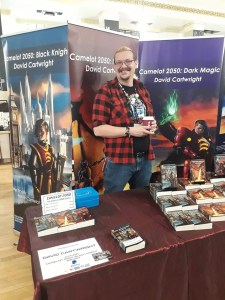
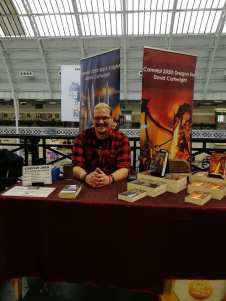
Having just had a three week run of events Conventions are back on my mind. Recently I was asked about attending events by a traditionally published author so I thought I’d do a brief recap of the process of booking and running a table and also the benefits and opportunities that can crop up along the way.

So, you have a book or books and a wholesale supplier for stock and you want to get out there and sell it. First you have to find an event, usually bookings will open up months in advance and, while I have been lucky enough to get into an event a mere two weeks before the doors opened, I wouldn’t advise leaving it so close to try and book. The cost for a table can range from as little as £20 for a smaller convention to around £170/£200 for the bigger events but, sometimes there will be artist/writer dedicated tables for lower cost. Event organisers to look out for are GoGeek, ShowMasters, Ytterbium or maybe MCM (if you’re feeling particularly ambitious).

My books are fringe Sci-Fi/Fantasy so those are the events I tend to go to (as well as more general literary conventions) and I tend to think of them in slightly different ways. The Film and Comic shows I attend are places for fans to cosplay and buy merchandise from their favourite properties but these are the conventions where I tend to make more sales (being one of only few attending authors/book traders) and these shows are about sharing my enthusiasm for my stories with prospective readers. I don’t hard-sell, I’ve done sales and I hate the tactic so I simply outline the story and if it ‘clicks’ with the person I’m talking to that’s great. As much as it’s about getting the story out it’s about getting it to readers who will enjoy it.

The literary con’s are where I’m more likely to make contacts and find out about opportunities like open submissions to publishers or other smaller shows who might be looking for panelists and speakers. I haven’t gotten on to a panel so far but then I’ve been casting a wide net to fill out existing talks, down the line I’ll be proposing subjects to talk about based upon my experiences.

Once you’ve made a booking you’ll want a few things for your stall. A stock of books is a given, a price list is advisable (if a customer can’t see a price they’re quite likely to just walk away), a lockable cash box, notebook to record sales and expenses, some promotional items like a banner and business cards (the attendee’s might decide to buy at a later date and a small reminder will help them find you online). A table cloth is also a good move and, in some circumstances, you’ll need your own table and a chair. You’ll get a vendors packet detailing times and where to be, how to get there in the run-up to the event so don’t panic too much.

Check out my earlier post ‘A Series of Promotional Events’ for a more detailed run-down.

Again, besides actual sales, the reason to attend these events is to put yourself out there, make contacts and look for opportunities. Most conventions allow for a ‘helper’ to attend with you and that ought to give you the opportunity to take brief breaks and walk around the other stalls so chat to other authors, artists and vendors and you’ll be amazed what might spring up in conversation. As my readership grows I’m starting to consider merchandise as another means to draw people in. Pin badges are a good one, lots of fans collect them and they can be bought in bulk for relatively low cost and given away. Printed bookmarks are another, like a business card with a practical purpose and these are things you can learn about or find sources for at events. Besides that it’s fun and it can inspire you or rejuvenate you. I’ve talked about ‘Post Release Drop’ and the best way I’ve found to rekindle my creativity and enthusiasm is to attend a Convention.

LFCC-SpringWookiemePFCC


Catch and Release, your work in the public domain.

Good morning readers, once you’ve trapped an idea, finished your story and released it upon the unsuspecting population what should you expect? This entry is just a brief, broad-spectrum of things you *might* experience after release.

Personally, after all the excitement of finishing the project, finalising the details and actually getting a copy in my hands I must admit to going through a period where I feel… flat. I call it ‘post release drop’ and I’m sure there are others out there who feel it too. All the excitement and frantic energy is released and then you have to wait to see how it does. Don’t worry, you’re not alone.

You might expect a deluge of  praise and congratulations and (if you’re promoting among friends on social media) you might well be justified in that, and the initial thrill of that validation is an important one to hold on to but; this is your achievement, not theirs and (harsh as it might sound) you can’t expect them to carry you on a wave of praise through your next project, you will have to knuckle down yourself.

You might draw some criticism, you might get some bad reviews. My first piece of advice for anyone putting themselves out there like this is ‘Don’t read the reviews’, you will (I did) but it’s much better to have someone else go through and help pick out any constructive points that might help you in future. Reading the positive reviews can be helpful but there’s always room to improve and we shouldn’t cocoon ourselves in an eiderdown of unfaltering positivism.

This next point is some experience I had years ago. I wrote a short I was going to submit to a publication with a certain intellectual property. In my eagerness I showed it to an acquaintance who shared my enthusiasm for this IP. Not long afterward they came back talking about a piece they were writing or going to write based on my work. Now, I was a novice at the time, I had no experience beyond putting my ideas on paper and my immediate reaction was ‘but this is mine’. Now, as I said, it was based in an existing IP but beyond that it was original characters and an original story and now someone else was proposing to write the follow-up. As I say I was very possessive of my work. If you’re writing your own story I’d say that’s a natural reaction but, if you’re freelancing on behalf of someone else and *they* want to change, add to, or otherwise ‘tamper’ with your material you can’t allow that feeling in. If you do work on behalf of another using their intellectual property you have to let it go.

Hopefully you’ll have an incredibly positive reaction to your releases maybe tempered by some constructive outside input. If you get out there and talk to people it can help immensely. I know this was quite a short entry and I wish I could put more thought into it but I’m getting to the end of three back-to-back weekend conventions and my brain is honestly fried.

Write what you know, learn what you don’t, and then write that too.

Forgive me readers for I have erred, it has been two weeks since my last blog update. The first week I can absolutely justify, I had a vile head cold and just wasn’t up to it. Last week (although I was also preparing for a convention over the Easter weekend) I just didn’t have an inspired thought in my head and, since this blog is intended to help fellow writers and give readers an insight into the creative process, I wasn’t going to ‘phone it in’. But I’m back!

This week I’m going to focus on avenues of research in the hopes that it will encourage you to step out of your comfort zone and challenge yourselves in your writing. Last year (as you might know) I was involved with a number of tabletop RPG projects and, because some of these were ‘real world’ settings I found myself doing quite a bit of factual research, largely of the historical nature. The project coordinator had encouraged all the writers to ‘go beyond Wikipedia’ in our efforts and (as convenient as that would have been) it was a great piece of advice. I picked up numerous tidbits from a range of sources that helped me flavour the final pieces so, by broadening my resource base it really helped me overall. That worked from a ‘History and Locations’ point of view.

Looking ahead I have in mind an Urban Fantasy series which I have been casually referring to as my ‘Soapbox’ series. The idea is to (through the veil of fiction) shine a light on societal problems as I perceive them because my writing is my forum and if I can attempt to better the world through that medium I feel obliged to do so. Now, whilst the scope of issues or themes that I might choose to cover is vast there is also the obligation to approach them from a position of informed sensitivity. This is especially true when you’re talking about themes of racial inequality, neuro-diversity and gender or sexual identity. For a very long time ‘minorities’ of all types have been the butt of the jokes in the majority of media franchises but, more and more, those characters are getting the opportunity to deliver the punch-line.

Now, I’m a white, straight, cis-gendered male and that gives me a lot of privilege among certain bands of society and, in my writing, I feel that I can use that white male privilege to promote diversity and equality. So, as I come up with the plots and characters for the series, it becomes my responsibility to do the research so that my well-meaning ‘support’ doesn’t, through my own ignorance of the life experiences of others, actually become a harmful factor. I want to be a good ally. There’s a lot of good reading out there on the subject, perception and experiences of people who are a part of these communities but actually talking to them is even better. Panels at conventions about diversity and representation are a great way to meet people who might be willing to guide your efforts down that path, it’s certainly the avenue I choose to follow.

Don’t get me wrong, I’m not writing a ‘Star Trek’ style Utopian society where there is no bigotry, the bigotry and the response to it is kind of the point. Imagine ‘Lord of the Rings’ meets ‘Lock, Stock and Two Smoking Barrels’, but the important factor is not to go at it casually and use established stereotypes, as with any other character, depth and a genuine knowledge of what their life experience might be like is so important. As an example, if I were to bring in an Ifrit or Jinn character (powerful spirits from Arabic /Middle Eastern mythology) to employ as an analogy for the Syrian Refugee Crisis then I have to have more than a casual understanding of the culture the character is coming from, the role they traditionally play within that culture, the politics behind the Crisis and the effect of a traumatic relocation upon the individual. It’s not good enough for me to pick a group that I only have limited knowledge of and write a character under the heading ‘representation’. I have to do the leg-work, talk to people from that community (especially when it’s a marginalised group) and actually know what I’m doing.

It sounds like a lot of work, I know it is going to be, but I also know it will be worth it to achieve what I hope to achieve, a cynical, satirical British-gangster comedy from the point of view of the supernatural creatures on the outside, looking in drawing in social groups, cultures and mythologies that you might not normally see represented.

I’ve got another book to finish first and I’m giving myself about a year for that project but that gives me lots of time to plan and research so that I can do it right. So, while I write the Sci-Fi adventure ‘Riding the E-Rail’ I will be researching the ‘Bentley Pennywhistle Heptalogy’ (working title).