
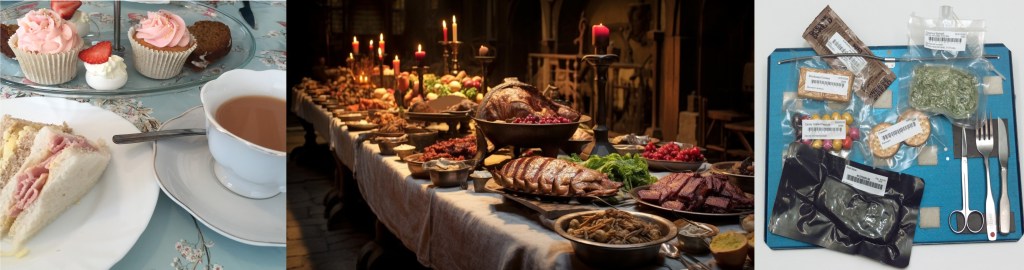
Bourbon and coffee on the mean streets, rehydrated rations on a starship, afternoon tea with the pastor, or a medieval style banquet in a castle in the sky. At some point, somewhere in our stories, someone sits down to eat, drink and (probably not) be merry, but why? A character on a page doesn’t need to eat, but by settling them into these particular scenes we can feed the audience insights as fulfilling as the food on the main’s plate and, through a smorgasbord of language, offer teasing bites into the world around them.
So, what’s the purpose of a meal scene? Firstly, it’s a recognisable social setting and whether your character is eating breakfast cereal while she mulls over events, or is tied to a chair watching some horrendous act of cannibalism. Within any meal sequence there are commonalities that can root the scene down in a kind of ritual of the mundane; even while the strange, magical or horrifying takes place around the characters, a starting point for the audience to identify with. Secondly it allows for something else to be happening to the character while acts of exposition or character/relationship development take place, for example;
The detective and assistant are discussing the particulars of the case, they do it over breakfast at a waffle house. The author flavours the thought processes taking place with such phrases as ‘I stared at the syrup left on my plate, gold and lustrous as the victim’s hair’, or; ‘Whoever was behind this had a heart as black as my coffee, and twice as bitter’. The scents, flavours and sensations of the food can also colour the scene, adding occasional breaks to the heavier prose.
Using food in a scene also opens up an entire larder of language to use for metaphor and simile. It’s almost a license to indulge in more florid, poetic language, if only for a scene. The language used to describe food, especially if it can be tied into the atmosphere of the setting or situation, can make the scene all the more flavourful, a touch of umami, if you will. It also allows you to illustrate certain characters’ traits, provide insights or foreshadowing. The uncouth manner when we observed Denethor eating (dear god, those poor tomatoes) cemented or enhanced the idea that he is an awful character. On the opposite end, Hannibal Lector sets a scene of impeccable refinement, just moments before delicately feeding Krendler a flambéed slice of his own brain.
Food in literature also speaks to the genre. You don’t often find deeper descriptions of cuisine in science fiction. Freeze-dried or dehydrated foods tend to appeal to the technology levels or settings for space-travel especially, where weight is a major concern for everything. If a luxurious meal is represented it is usually a means to illustrate the difference between situations (starship vs planetary), species and their physiology (think Gagh), or levels of technology, civilization or culture.
Food in post apocalypse settings spins between rediscovering how to make/grow your own, and scavenged tins or rediscovered delights. The food of the aftermath of whatever is either a tribute to the courage and endurance of the survivors enjoyed as a community, an illustration of scarcity, or a guilty throwback to the times before, like a chocolate bar enjoyed in secret but bittersweet at the same time.
Fantasy tends to lean into western medieval traditions, bread, cheese and roasted meats and vegetables, stews, wines and beer. You’d be lucky to find a plate of linguini in the whole of Westeros. A recent challenger to this particular trope is the Manga (and Netflix Anime) Delicious in Dungeon which has raised the bar for fantasy food and introduced a definite eastern appeal, but it’s the show’s focus on food that leads to an interesting recent arrival on the scene, Cosy.
Cosy Fantasies (and the growing trend of Cosy Sci-Fi) take a departure from the more visceral aspects of their industry counterparts. In cosy, food takes a rather more prevalent role, and it’s most closely aligned to cottage-core. The bread and cakes are hand-baked, teas and wines are many and varied, the dishes served are levels of complexity removed from the usual fantasy fare, and so are the descriptions. The setting uses food to enhance a sense of loyalty, friendship and camaraderie, and meal scenes have long been a focus for just that, with the effort and care of preparing these fine victuals adding to the sense of homeliness and comfort.
So, food is an important part of our everyday lives, and it deserves to be represented in literature. From fast-food grabbed on the way to a big heist, to a gourmet meal shared between uneasy allies. When vampires grab a quick-bite, or the aliens share a banquet that brings worlds together, food and the setting, situation, and language used around it can add that last spice to your work. When the recipe calls for it, that is.






 David Cart-Writer