
Fiction fans? Sociopaths? Never! Well, not really. But! We do like to see characters getting what they deserve, whether it’s the honest cop getting a medal for taking down the criminal element at the precinct, the loveable underdog thief making it off with the amoral billionaire’s money or… the villain of the piece getting their final comeuppance. We all love to observe justice being done and, in the world of fiction, there’s no two-ways about it. The villain done bad, we saw it, we rode along with it, we heard their flawed justification for their actions and (mostly) we decried their logic and waited expectantly for them to get theirs. Morally justifiable villainy is becoming more common wherein it’s the actions rather than motive or goal that’s the criminal part, but that can be played into anti-herodom and it’s a more complex subject overall. For now, straight-up villains is the subject.
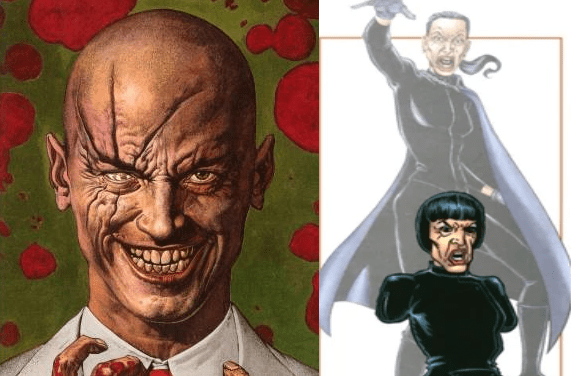
Herr Starr – Preacher, Vertigo Comics , Ma Gnucci – Punisher: Welcome Back Frank, Marvel Comics, Garth Ennis/Steve Dillon
The question is, “How do we satisfy the audience that ‘justice’ (a purely subjective term liable to be interpreted differently by a host of readers across the fan base) has been done?” How do we balance the scales in a satisfying manner? Of course there is the aspect of Genre. In the cases of Hercule Poirot, or Miss Marple, having your scheme outlined before a jury of your peers before suffering a cutting remark and being arrested will suffice. In many cases the villain is defeated, only to make a last gasp attack that results in them killing themselves (think Lord Chen – Kung Fu Panda 2) or the hero kills them, either grudgingly or as the logical conclusion of the plot.
Of course, then there are the examples pictured above from the Ennis/Dillon collaborations on Preacher and Punisher. Both Herr Starr and Ma Gnucci go through the ringer before meeting violent ends (Ennis does like to muiti;late his villains). So, taken away in cuffs? Or thrown from the train? How do we achieve narrative satisfaction? What is justice?
Initially the scale of response to a villains crimes is established early on in the tone of the book. It wouldn’t make sense for Miss Marple to gun down the vicars wife who poisoned her estranged sister with a victoria sponge over the family inheritance. Likewise John Wick doesn’t hand his enemies over to the police for a fifteen-to-twenty stretch or outline their dastardly schemes in front of their social peers. Once tone has been established, whether our protagonist plays by the rules or gets the job done kind of thing, are the authorities to be trusted? Or in the employ of our villain? Then we set the level of expected repercussion. In a teen drama you might expect an elaborate prank played on the bully before they are outed and sent to military school. In a spy novel, the evil genius might be dropped into the scalding water of the atomic reactors cooling chamber (Doctor No – United Artists 1962).
We tend to gain points with the reader for creativity, a little ingenuity in the demise under certain circumstances is appreciated but, sometimes a very clear clean ‘Bang!’ ending is the required payoff. It can be satisfying for the villain to bring about their own, ultimate demise, usually as a result of some kind of attempted underhand final attack or simply by their own refusal to accept that they were wrong/are beaten.
Of course, maybe the sign of a deranged mind is not *What* you do to your villains (or victims) but *How* you do it, that is, how much detail you go into. I like my horror, I read the Rats trilogy by James Herbert at a formative age. Desperation and The Regulators by Stephen King sit on my shelf, also creature horrors like Jaws by Peter Benchley and Jurassic Park by Michael Crichton (and it is, in places, the book goes into much more detail than the film). But between horror, fantasy and science fiction, where do you draw the line at too much gore (gore being the measure of detailed description about the fate befalling an unlucky character)? Again, it’s a bar you ought to have already set earlier in the book. You can’t ambush your reader right at the end with an in-depth description of gut-wrenching visceral imagery if you haven’t done so already. Some readers aren’t prepared for that, and those that are? They’re probably asking where was this fifty to a hundred pages ago?
Of course there are the gore-hounds and there are the people who think less is more. A few well-crafted hints about what’s happening can terrorize an over-active imagination and, by far the bulk of fiction readers are in possession of one of those. So what is the worst way for your villain to go out? Death by drowning/suffocation? Maybe, if it’s actively at the hands of the protagonist, supposedly it’s quite peaceful once you overcome the panic and reach the stage of acceptance, or so I’ve heard. Massive trauma, car accident or crushing? Maybe, it covers a multitude of violent death scenario’s, and it’s something hundreds of thousands of people around the world have real experience of. Anyone who’s fallen off a bike, been hit by a car or been in a car crash will be able to identify and it’s that connection with the reader that is a powerful tool when writing a narrative. Long fall, opportunity to draw out the moment, have the characters reflect or observe the villains reaction as they drop, think Hans Gruber or ‘Ma-Ma’ Madrigal. Death be fire is a grisly business, as is being eaten alive, both tap into areas of primal fear, those things that scare our animal ancestors still scare us, and for good reason.
No matter what you decide to do to shuffle your antag off the mortal coil the best deaths tent to carry a hint of irony, that balancing of the scales that gives them a taste of what they’ve been dishing out. In fantasy and science fiction the idea that the villain is going to die is almost a given but it’s the satisfaction for the reader that, like every other part of the book, really has to hit home, a bungled ending can sour the entire reading experience and that makes the reader remember you for all the wrong reasons.
So what is it for us, the writers and readers? Is it justice? Vengeance? A response to the day-to-day unfairness we see in the world around us? Well, yes, sometimes. Most of the time I think it’s just narrative. We emulate what has gone before and what has gone before is drawn from history. Let’s not forget the unjust rulers who were killed by a red-hot poker in the bottom (Edward II), or stabbed up the guarderobe (Wenceslaus III), suffocated under a pile of clothes (Draco) or lured to their death in a fiery pit (Susima). Remember, when offing your antagonist, this is the payoff. It ought to be memorable, and appropriate to their actions, but don’t let yourself get too indulgent in the act, or people might really start to believe that you’re a little cracked yourself.
 David Cart-Writer