
Representation is something that is very important to me, not because I have anything particular to represent, but because I know so many people who do who have no platform or are outright afraid of the negative attention it might draw their way. Let’s be clear, representation is not about ‘Brainwashing’ or ‘Overwriting Traditional Values’, it’s about giving a more accurate cross-section of the society we live in, it’s about discouraging false, inaccurate or harmful stereotypes and generating empathy through familiarity, the familiarity of life through a lens. Prejudice is not inherited, it is taught.
So, when talking about representation, one of the more overlooked areas (because it’s not such a controversial political hotbed) is disability rep. One of the enduring influences in my work is the Saturday Morning Cartoons I watched in the late 80’s and early 90’s. Many of those properties feature characters with bionic limbs or implants. At the time I never considered these characters as disability rep and after a round-about mental journey and some proper education I still don’t.
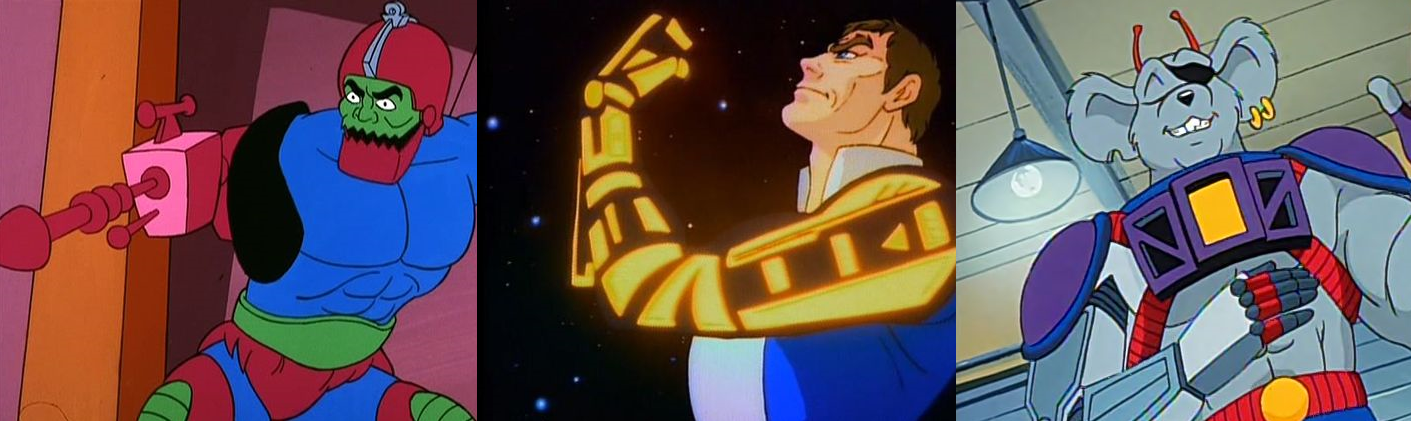
Trap Jaw – He-Man (Mattel 1981), Zachary Fox – Galaxy Rangers (Transcom Media 1986), Modo – Biker Mice from Mars (Disney 1993)
The problem with calling these Saturday morning heroes as representative (aside from the massively male-dominated pool of source examples) is that, in most cases their bionics or prosthesis work as well or even better than a flesh and blood limb. Usually they bestow some power or ability and rarely do we see any particular downside. On the rare occasion that the reliability of the limb is called into question it’s usually as a ‘dark temptation’ ploy where the hero is offered a superior model by the villains. Pre-teen me didn’t look at these characters and think “Oh wow! Disability rep!” what I actually thought when I watched these shows and saw a bionic arm was “Cool! When do I get mine?”
It’s an easy trap to fall into, especially in the genres of Fantasy or Science Fiction. If your world relies on physical ability for the relatively simple narrative principal of travelling from place to place via horseback or if your settings medical sciences are still at the most formative stages, then you might think it out of place to have a disabled character. To that I say take yourself to the internet and make a study of the Paralympics Equestrian events, and that’s just for a start. I’m not usually one to bring up A Song of Ice and Fire (George R.R. Martin 1996) but it’s the most mainstream property I can think of to have a disabled character in the main cast – King Bran the Broken. Having disability in a fantasy property isn’t in anyway unrealistic, (stone age societies could drill holes in peoples skulls to relieve pressure on the brain, a procedure many survived) and if your main objection is that it’s ‘inconvenient’ then, truthfully? That’s just lazy. If you don’t think you can do it right? That’s a fairer excuse. Writing is a skill that improves with practice, as is researching.
In Science Fiction we come across the opposite problem, it’s too easy to *think* we’re doing disability rep through the medium of bionics or advanced sciences when, in fact, all we’re doing is contributing to disability erasure. Having bionics is also used as a fight scene mechanism, allowing for a protagonist to be ‘injured’ or limited without anyone actually getting hurt but, quite obviously, if you were to drag my arm out its socket, break any one of the bones, or tear the major muscles and ligaments, I wouldn’t be very combat effective either. I’ll admit, when I wrote the character John Loxley in Camelot 2050, I wasn’t even thinking about representation, I was paying homage to the characters I enjoyed who had bionics. I’ll also admit that, later on in my enthusiasm, I might have thought in retrospect, that I *had done* disability rep without being aware of it. I was wrong, as this article illustrates. I don’t include Jay from Rendered Flesh either; the reveal for that character is a late-stage knife to the heart for the reader (trying to be vague so as not to spoil if you haven’t read it). No, my ‘better’ disability rep is to come in Riding the E-Rail (which is in editing and should be going to print in the New Year).
I have included bionics in E-Rail, prosthesis designed to help amputees but, I have gone further. In writing the ship’s Doctor, ‘Doc’ Rammitz, I created a character afflicted by a condition brought about by a chemical weapon that attacks a species genome, inflicting a condition not unlike Muscular Dystrophy. Of course, many diagnoses like that have sympathetic (or not!) conditions and I have a number of friends with Fibromyalgia and Myalgic Encephamyelitis (Chronic Fatigue Syndrome) and many of them are *the same friends*. Anything that impacts significantly on your quality of life is very likely to have knock-on effects. Now, while Doc’s condition isn’t the story what’s important is that the way that it is approached within the narrative. Firstly, it’s incurable and it is acknowledged as such, there’s no desperate bid to find an advanced technology that can ‘cure’ Doc. The impact on Doc’s health when the character is, at one point, force to operate without their usual support apparatus is massive. And I included a planet so styled and polished by its corporate identity that facilities to accommodate disability are largely unknown. Doc is even uncomfortable setting foot on it, feeling that they will look ‘unsightly’ struggling to get around, a problem absent upon most other planets/places but altogether too common in our own real-world.
In case you’re wondering, the condition brought on by the bio-weapon is called ‘Erasure Syndrome’.
So, while I won’t claim to be the best at representation, or even very good at it, I can acknowledge how far I’ve come in a short span and my ongoing attempts to be sympathetic in my examples of representation, even while I employ them to make scathing commentary on the short-comings of our society in including those communities I’m trying to represent. The most important thing to remember all the while though, is the phrase “With Us, Not For Us”. You need to try to understand those people who are the focus of your representation, talk to them, show them before you publish. The value of Sensitivity Readings cannot be undersold and that is ‘having someone from the group you are trying to represent, who lives with that condition/bias/stigma every day, read your work’.
In a world that is becoming less and less empathic/caring/understanding every day, where simple differences of identity/lifestyle/ideology are weaponised against innocents, representation through Media is so, so important. It’s easy to be made to fear that which you don’t understand. Knowledge is the enemy of Fear, not Courage. But, to have the courage to stand against those who employ fear as a weapon? To stand up and say ‘I want to be an ally’, that is a way forward for us all, together.
 David Cart-Writer