
You will often hear me saying that “Other writers aren’t competition.” and this, by and large, is true. The pool of readers among whom we disseminate our works is vast with wide-ranging tastes and, in the majority, someone who reads Adrian Tchaikovszy’s work isn’t going to snub Gareth Powell or Kameron Hurley simply because they aren’t Adrian Tchaikovsky.
But, there are divisions in the industry based upon genre and your likelihood of getting published and how you get marketed after publication can depend upon how you phrase your pitch, for example;
Sci-fi/Hard Sci-fi/Space Opera
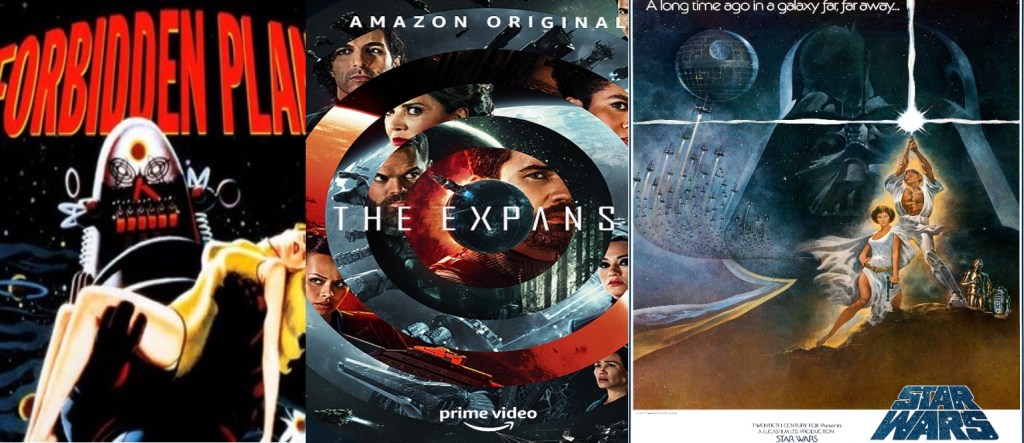
Forbidden Planet (1956, Warner Bros), The Expanse (2016, Amazon TV), Star Wars – A New Hope (1977, 20th Century Studios)
The differences in these cases can almost be dialled down to… Something Happens in Space, Something Happens in Space – There is Maths, and A Big War Happens in Space – Cue Chivalry, Romance and to Hell with the Laws of Physics.
Of course, securing a breakdown of specific information is quite an involved web search but, while WordsRated.com has the U.S. Market for Science Fiction (combined with Fantasy) accounting for nearly Six-Hundred Million dollars (domestic) they also state that less than 5% of authors make a living from writing alone.
Both Science Fiction and Hard Sci-Fi can be regarded as trying to retain a certain amount of realism (whether there are aliens or not). Star Trek (1966, Gene Rodenberry) frequently straddled the line between Sci-fi and Space Opera but the difference between ‘Hard’ and ‘Soft’ science fiction is the attention to detail. Theoretical Physics, Mass-Velocity Calculations, actual maths in application and, make no mistake, there is a massive market for it. However, more and more the lines are blurring back into each other. You can have a massive, over-arching space war with romance arcs, seat-of-the-pants and ventures *and* realistic environments, theoretical biology’s and the application of astrophysics.
Horror and Humour
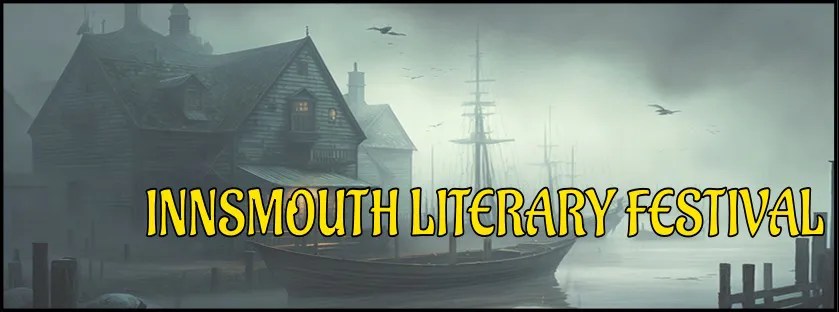
Innsmouth Literay Festival Banner, held 30th Sept 2023 Bradford UK
In my experience of the industry to date I have come across certain attitudes towards several genre’s (at least one I won’t go into for fear of the readership) but in the case of Horror and Humour I certainly feel there is a strong division from the Sci-Fi/Fantasy market. That’s not to say that many, many titles don’t include strong aspects of these genres but, if you push too hard, if your book is too funny, or too horrifying, then you risk getting bumped out of Sci-fi/Fantasy and into Horror/Humour and therein there are risks. Books marketed under the ‘Purely Humorous’ will struggle to find a publisher because humour is so subjective. You’ll find that the majority of authors of successful humour are established comedians themselves wherein people already know what to expect, an unknown is unlikely to sell. Within Sci-Fi/Fantasy, humour is often seen as a ‘poor cousin’ at least by the bigger publishers, which annoys me as I loved the Myth Inc and Phule’s Company series’ by Robert Asprin and, I’m sure, comes as a huge surprise to New York Times best-seller Jasper Fforde. Horror is widely regarded as its own genre, in 2018 a ‘boost’ in sales up to Four-Million Dollars was seen as a domestic ‘win’ for U.S. publishers but, when comparing this to the Sci-Fi figure stated above we should remember that Fantasy and Comics had been included and also (for some strange reason) Steven King counts in the WordsRated list of Top Ten fantasy authors of all time. No I’m not forgetting the Dark Tower but I do wonder if his sales to date have accounted for his vast catalogue of pure horror for the purposes of that analytic. In fact, for the longest time, Horror hasn’t had its own UK dedicated literary convention, getting lumped in with the (admittedly fabulous) more generic Horror fandom conventions. This year marked a change as the Innsmouth Literary Festival marked its inaugural event and, I’m sure, we look ahead to a bright future for that convention and the representation of horror literature on the UK convention scene.
‘Why is it important how I’m marketed?’
Well, the vast majority of readers are very canny; they will identify your book probably as you intend it to be identified. They are open to the representation of subtle sub-genres and genre-mashing. And it’s not that the industry isn’t, so much, it’s just that they like to tick boxes. Focussed marketing is widely believed to yield the best returns for financial outlay; broad-spectrum marketing is a much less desirable cost/return gamble. So publishers like to pigeonhole titles to trigger keyword searches. It doesn’t matter so much in Barnes and Noble, all the Sci-fi goes on the sci-fi shelf, but the physical bookstores account for less and less of the Publishers income every year.
“So Why Don’t They Just Broaden the Keyword Range?”
Another reason for Focussed Marketing is to mitigate damage, the Publisher doesn’t want a title falling into the wrong hands which, for the purposes of this argument, is anyone who’s going to take to Amazon/GoodReads/FaceBook etc and leave bad reviews and bad reviews kill books. That’s not to say that good reviews can’t be damaging too. Too many glowing Five-Stars and people might start to suspect some foul-play; I’ve certainly happened across the ‘Reviews for Cash’ scene, people selling reviews from themselves and their followings. Still, I’m pretty sure the sales execs don’t see it that way.
As I’ve often said, the way to succeed (if not what would widely be considered ‘success’) is to find those readers who will enjoy and value your work for what it is. The surest way to do that is face-to-face sales and accurate representation of your work when marketing. That’s not to say that you can’t cast your keyword net wide but your blurb will be the first thing that comes up in that search so, if there are wildly differentiating elements within your story, you have to be upfront with that. Currently I’m in collaboration on a story that interweaves High Fantasy, Cyberpunk and Post-Apoc settings, that’s going to be an absolute ‘joy’ to set the marketing for!
 David Cart-Writer